

In 2021, Wavelogix partnered with INDOT and Purdue University to enhance road and bridge...
Choosing the wrong concrete testing method can cost you days, dollars, or both. There are four main approaches -- cylinder break tests, the maturity method, acoustic resonance sensors, and rebound/penetration testing -- and each one fits a different situation. This guide breaks down how they work, what they cost, and when to use each.
1. Cylinder Break Test (Compressive Strength Test)
What it is:
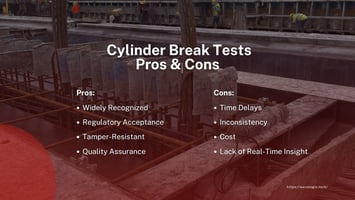
Concrete is cast into cylindrical molds at the job site, cured under controlled conditions, and then crushed in a lab at intervals (typically 1, 3, 7, 14, and 28 days) to determine compressive strength.
✅ Pros:
- Widely accepted and standardized (ASTM C39)
- Familiar to labs, contractors, and inspectors
- Often required for compliance documentation
❌ Cons:
- Delayed results (wait days or weeks)
- High variability due to handling and curing inconsistencies
- Can’t provide real-time insights or early decision-making
- Requires multiple samples and transportation to labs
✅ Best used when:
- Regulatory compliance requires it
- Independent third-party verification is needed
- Historical comparison with past projects is useful
- Teams without access to real-time sensor technology
2. Maturity Method (Embedded Thermocouples)
What it is:
The maturity method utilizes embedded temperature sensors to monitor the heat development during the curing of concrete. A pre-established calibration curve, based on lab-tested mixes, estimates strength over time (maturity curve).
✅ Pros:
- Provides early-age strength estimates
- Inexpensive and widely used
- Can help with formwork removal and scheduling
❌ Cons:
- Requires prior calibration for each mix design
- Dependent on accurate temperature recording
- Susceptible to error in extreme weather conditions
- Requires upfront investment of sensors
✅ Best used when:
- You’re using a consistent mix design across pours
- Projects benefit from early strength data to optimize schedule
- Cost-effective strength tracking is needed
3. Acoustic/Resonance-Based Sensors ( REBEL® Sensors)
What it is:
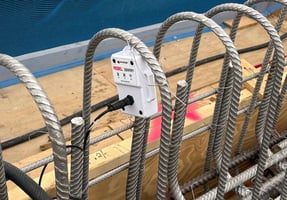
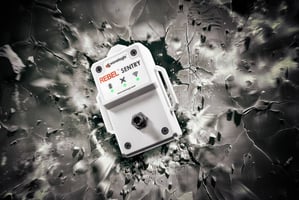
These sensors measure changes in the resonant frequency of concrete as it cures. REBEL by Wavelogix, for example, utilizes acoustic resonance to track strength development without requiring calibration.
✅ Pros:
- Real-time strength data for up to 56+ days
- No calibration required – works across any mix
- Independent of temperature, moisture, or handling
- Reduces reliance on lab testing and cylinders
- AASHTO T412 compliant
❌ Cons:
- Requires upfront investment in sensors
- May be unfamiliar to crews used to traditional methods
✅ Best used when:
- You need real-time decision-making for faster builds
- Want to eliminate costly delays and disputes
- Looking for low-variability and high-accuracy data
- Validating concrete in remote or high-volume projects
4. Rebound Hammer / Penetration Testing (Surface-Based)
What it is:
These are non-destructive tests (NDTs) that measure surface hardness (like the Schmidt Hammer) or penetration resistance to infer strength.
✅ Pros:
- Quick and portable
- Non-destructive
- Useful for quality control or comparative checks
❌ Cons:
- Less accurate for structural validation
- Only assesses surface conditions
- Influenced by surface finish, moisture, and carbonation
✅ Best used when:
- Spot-checking in the field
- Evaluating existing structures for uniformity
- Supplemental to other methods
Choosing the Right Method: A Quick Comparison
|
Concrete Testing Method |
Real-Time? |
Calibration Needed? |
Cost |
Ideal For |
|
Cylinder Break Test |
❌ |
❌ |
$$ |
Compliance & lab validation |
|
Maturity Method |
⚠️* |
✅ |
$ |
Early strength for schedules |
|
Acoustic Sensors (REBEL) |
✅ |
❌ |
$ |
Real-time, high-accuracy insights |
|
Rebound/Penetration |
⚠️ |
❌ |
$ |
Non-destructive field spot checks |
*Real-time estimates are possible after calibration.
Final Thoughts
There’s no one-size-fits-all solution when it comes to testing concrete strength. It’s about using the right tool for the right job—or combining methods to cover all your bases.
That said, modern solutions like REBEL® Concrete Strength Sensors are quickly becoming the go-to method for projects that demand accuracy, speed, and confidence.
Want to learn more about how REBEL® can modernize your concrete strength testing approach? Visit www.wavelogix.tech.
FAQS
What are the four methods for testing concrete strength?
The four main methods are: cylinder break tests (ASTM C39), the maturity method using embedded temperature sensors, acoustic resonance sensors like the REBEL® system, and rebound/penetration testing. Each method measures strength differently and suits different project needs.
What is the most accurate method for testing concrete strength?
Acoustic resonance sensors offer the highest in-place accuracy because they measure actual strength development within the pour. Not a lab-cured sample or a temperature estimate. Cylinder breaks remain the standard for compliance documentation but test samples cured in controlled lab conditions, which may not reflect actual field performance.
Can concrete sensors replace cylinder break tests?
In some cases, yes. REBEL® sensors are AASHTO T-412 compliant and have been formally approved by state DOTs for concrete strength certification and payment authorization on certain project types. Requirements vary by state and project, so verify with your project engineer or DOT.