
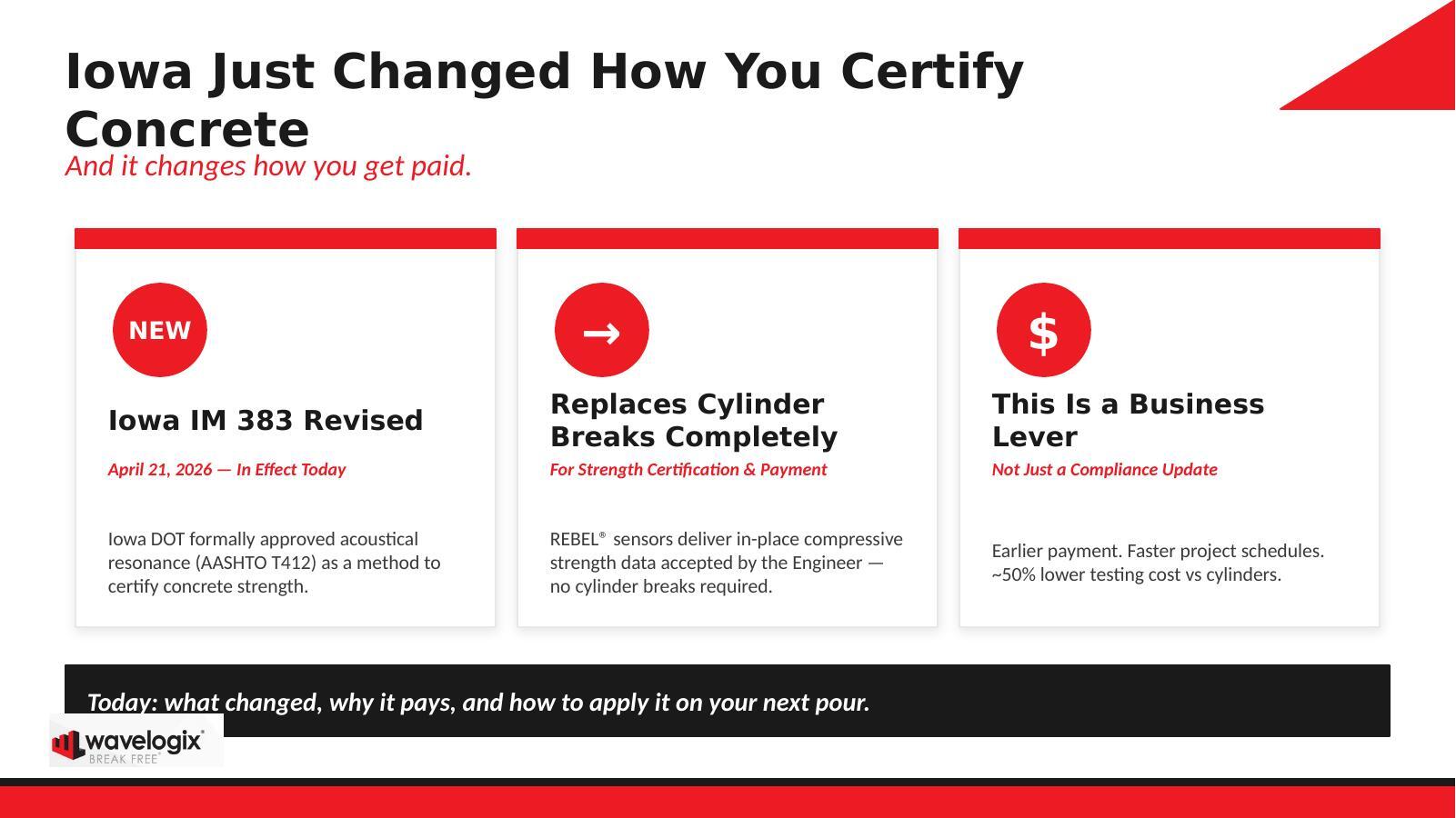
On April 21, 2026, Iowa DOT changed the Materials Instruction 383. In just a few paragraphs, the state formally approved acoustical resonance under AASHTO T412 as a valid method for estimating in-place concrete strength on state projects, despite nine pages covering the maturity method. It's a regulatory change that most contractors haven't noticed yet. But it changes how they get paid.
This morning, Wavelogix CEO Joe Turek and Technical Sales Specialist Felicia Bahr hosted a live webinar walking Iowa contractors and DOT project teams through exactly what changed, what it means operationally, and how to apply it immediately. Here's what you need to know.
What Exactly Changed
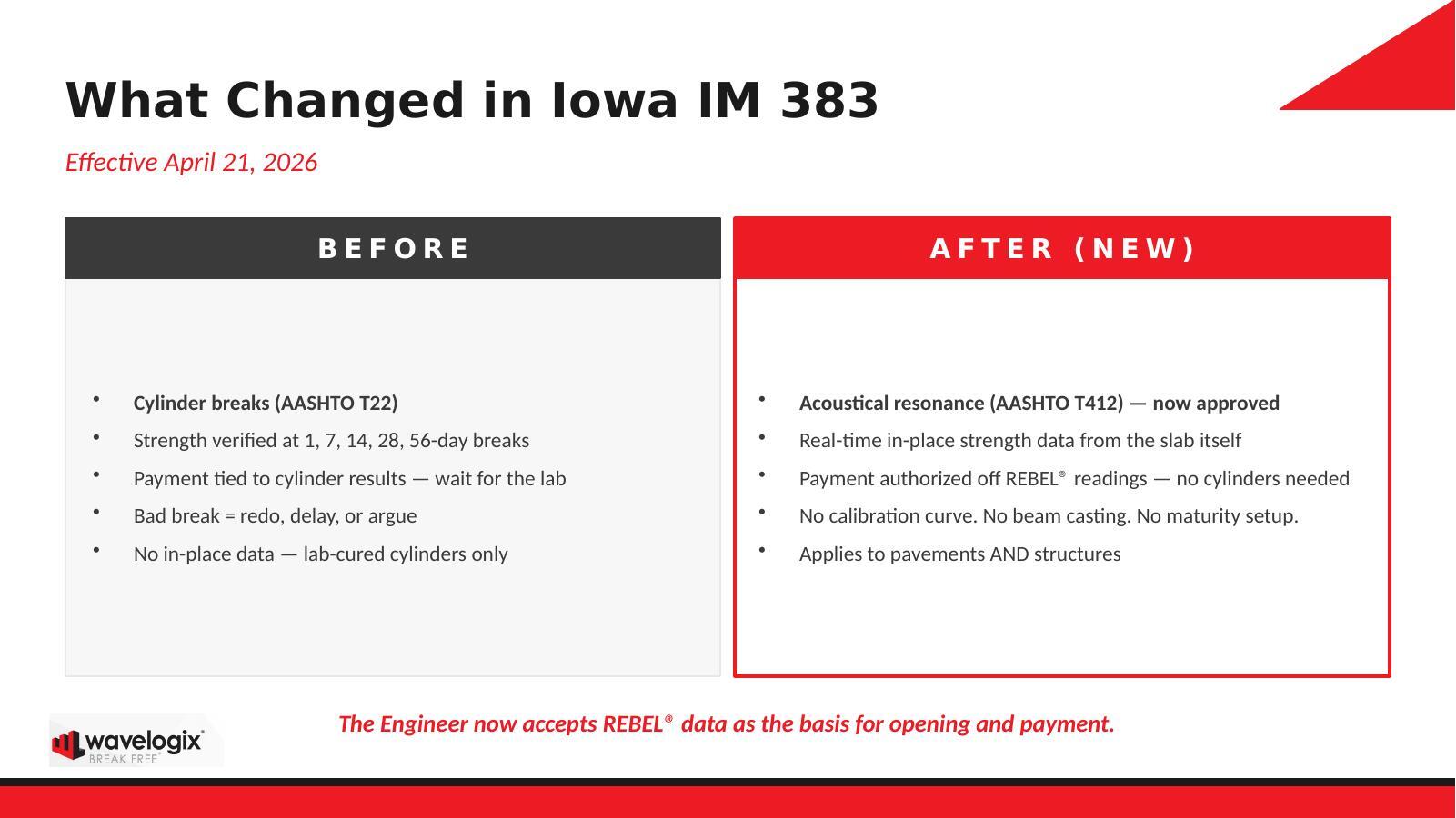
Before April 21st, Iowa contractors certifying concrete strength had one path: cylinder breaks per AASHTO T22, with strength verified at 1, 7, 14, 28, and sometimes 56-day intervals. Payment was tied to those lab results. If a cylinder failed, whether because of bad concrete or bad handling, everything stopped.
BEFORE
- Cylinder breaks (AASHTO T22) only
- Strength verified at 1, 7, 14, 28, 56-day intervals
- Payment tied to lab cylinder results
- Bad break = redo, delay, or dispute
- No in-place data — lab-cured cylinders only
AFTER (NEW)
- Acoustical resonance (AASHTO T412) — now approved
- Real-time in-place strength from the slab itself
- Payment authorized off REBEL® sensor readings
- No calibration curve, no beam casting, no maturity setup
- Applies to pavements AND structures
"Iowa was the first state to actually approve the use of our acoustic REBEL sensor as a replacement for cylinder breaks, completely replacing cylinder breaks and maturity. That's really, really great."
— Joe Turek, CEO, Wavelogix · from today's webinarThe practical upshot: the Engineer can now authorize opening and payment based on REBEL® sensor readings alone. No cylinders required.
The Real Cost of Cylinders
Turek didn't mince words about the cylinder process. "Is there anyone out there who likes cylinders? I don't see anyone raising their hand," he said during the Q&A. "They're just horrible." The problems are well-documented by anyone who's spent time on a DOT paving job:
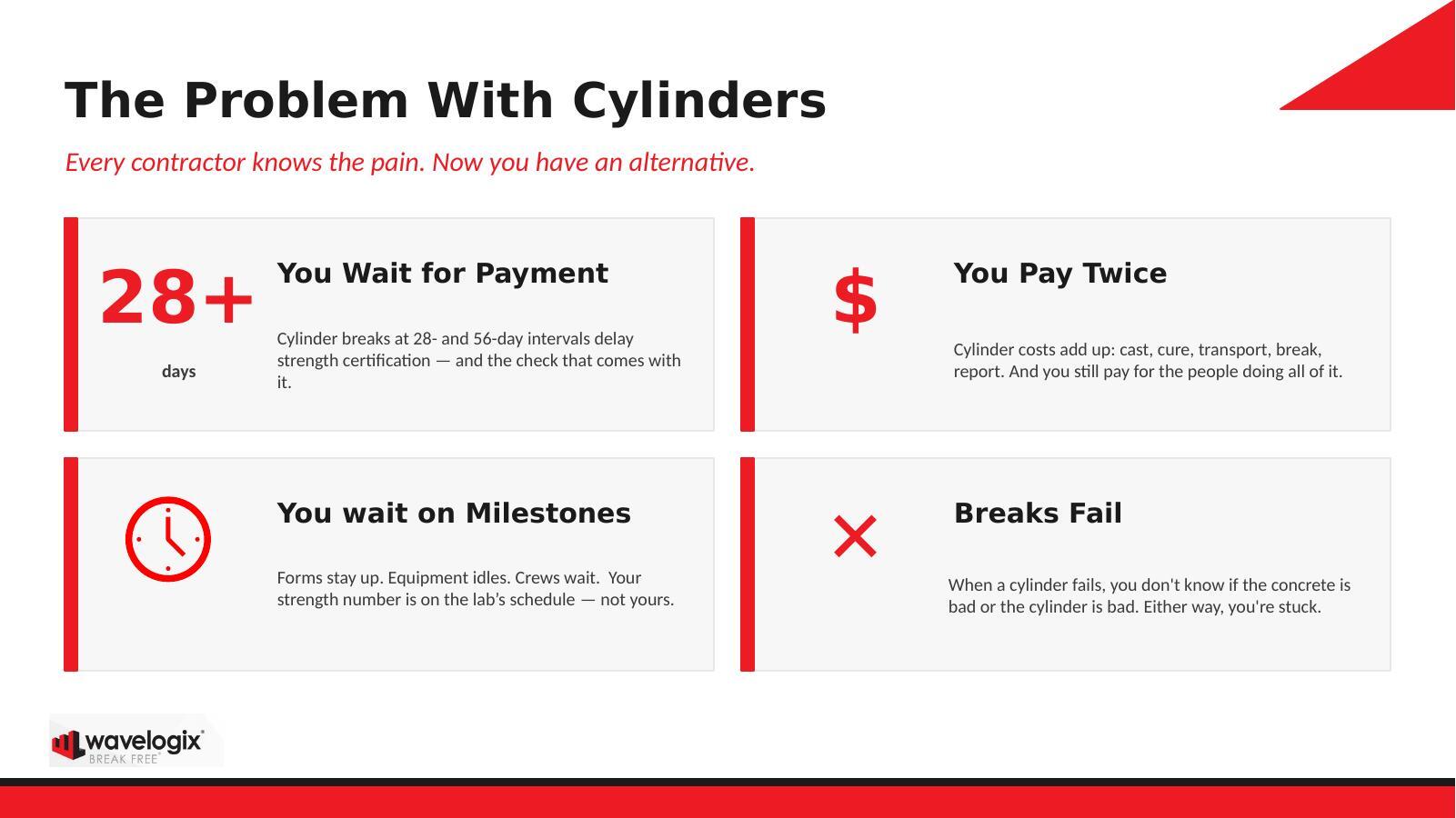
Felicia Bahr, who spent years as an ACI-certified strength technician before joining Wavelogix, added the perspective of someone who's lived it: technicians routinely get called in for overtime cylinder breaks at 4 a.m., 8 a.m., and odd-hour intervals just to hit spec windows. And if the cylinder misses at that break? The road stays closed and the crew waits.
"The biggest thing with testing for pavement opening is you have all that overtime — technicians have to break those cylinders at 8 hours, whatever they need to be. Now there is no technician. You're not paying for that technician to come in."
— Felicia Bahr, Technical Sales Specialist, WavelogixHow the REBEL® System Works
The REBEL® Sentry is a piezoelectric sensor that embeds directly in fresh concrete. A disc generates acoustic signals through the concrete matrix; as the material cures and its crystalline structure develops, those signals shift in measurable ways. An onboard data logger captures the readings and transmits them via cellular LTE to a cloud dashboard, where an AI-guided algorithm converts the acoustic data to compressive strength values.
Updates arrive every 30 minutes for the first 48 hours — from the first hour after the pour. Contractors, inspectors, and engineers all see the same live strength curve on their phones, tablets, or laptops. When strength hits the required threshold plus 10%, the system sends an automated notification to the Engineer, who authorizes opening and payment.
- 30 - minute data update interval
- ~50% Cost savings vs. cylinders
- 9–10 Days earlier to certified strength
Turek noted that across thousands of deployed sensors, concrete typically reaches certified strength 9 to 10 days before the 28-day mark, usually in the 18–21-day range. At early milestones, REBEL® data tends to arrive 1–2 days before the first cylinder break would have occurred. For a contractor financing a multi-million dollar project, those days matter.
REBEL® vs. the Maturity Method
Iowa IM 383 also allows the maturity method (AASHTO T413), which some teams have used for early-strength decisions. Turek and Bahr compared the two approaches head-to-head during the webinar.
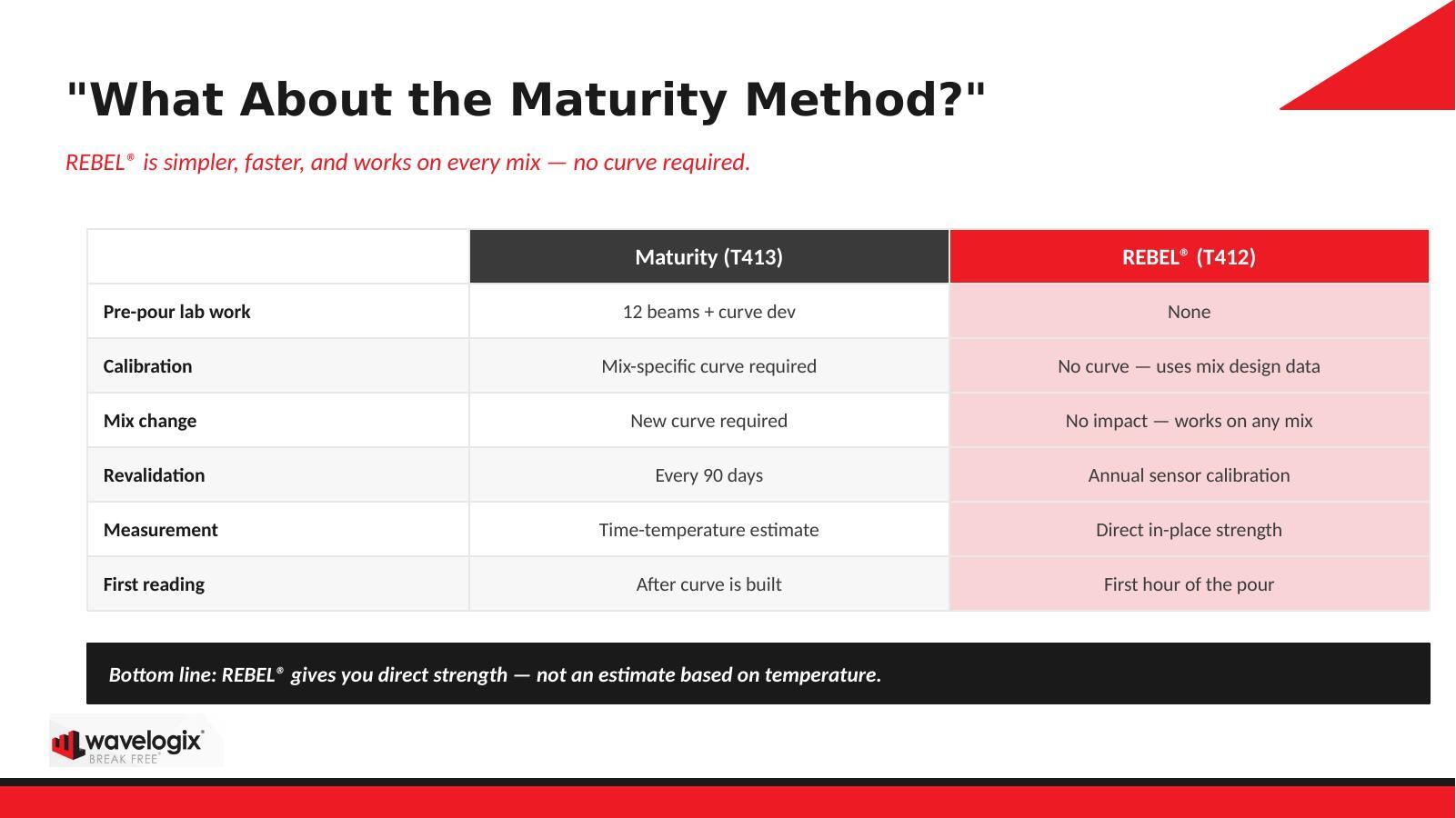
The core difference: maturity measures time-temperature history and estimates strength from that curve. It requires 12 lab prep beams per mix, recalibration every 90 days, and a new curve whenever the mix source changes. REBEL® bypasses all of that. It's mix-agnostic, requires only annual sensor calibration at the factory, and delivers direct acoustic measurement of in-place strength, not a temperature-based estimate.
"The no-calibration-curve is the game changer. All those maturity curves, especially with Type 1L and the differences it's causing, you'd have to run them all the time. There's no knowing if your curve is always accurate. The fact that there are no calibration curves is just amazing."
— Felicia Bahr · from today's webinarBahr shared a story from a job site where a ready-mix truck broke down mid-project, and another plant had to supply concrete, with no existing maturity curve. A REBEL® sensor resolved the situation immediately. "He ran in with a Rebel sensor and saved the day," Turek recounted.
The Numbers: When Can You Open?
Under Iowa IM 383, compressive strength thresholds are expressed with the required +10% built in. Here's what REBEL® needs to read before the Engineer can authorize opening:
- 350 psi flexural required → REBEL® must read 2,750 psi compressive
- 500 psi flexural required → REBEL® must read 3,850 psi compressive
- 575 psi flexural (structural forms) → REBEL® must read 4,400 psi compressive
For structural concrete requiring 4,500 psi or greater, consult your District Materials Engineer. The Engineer makes the final determination on opening in all cases.
Case Studies: What This Looks Like in Practice
Turek walked through three real-world deployments to show the financial and operational impact.
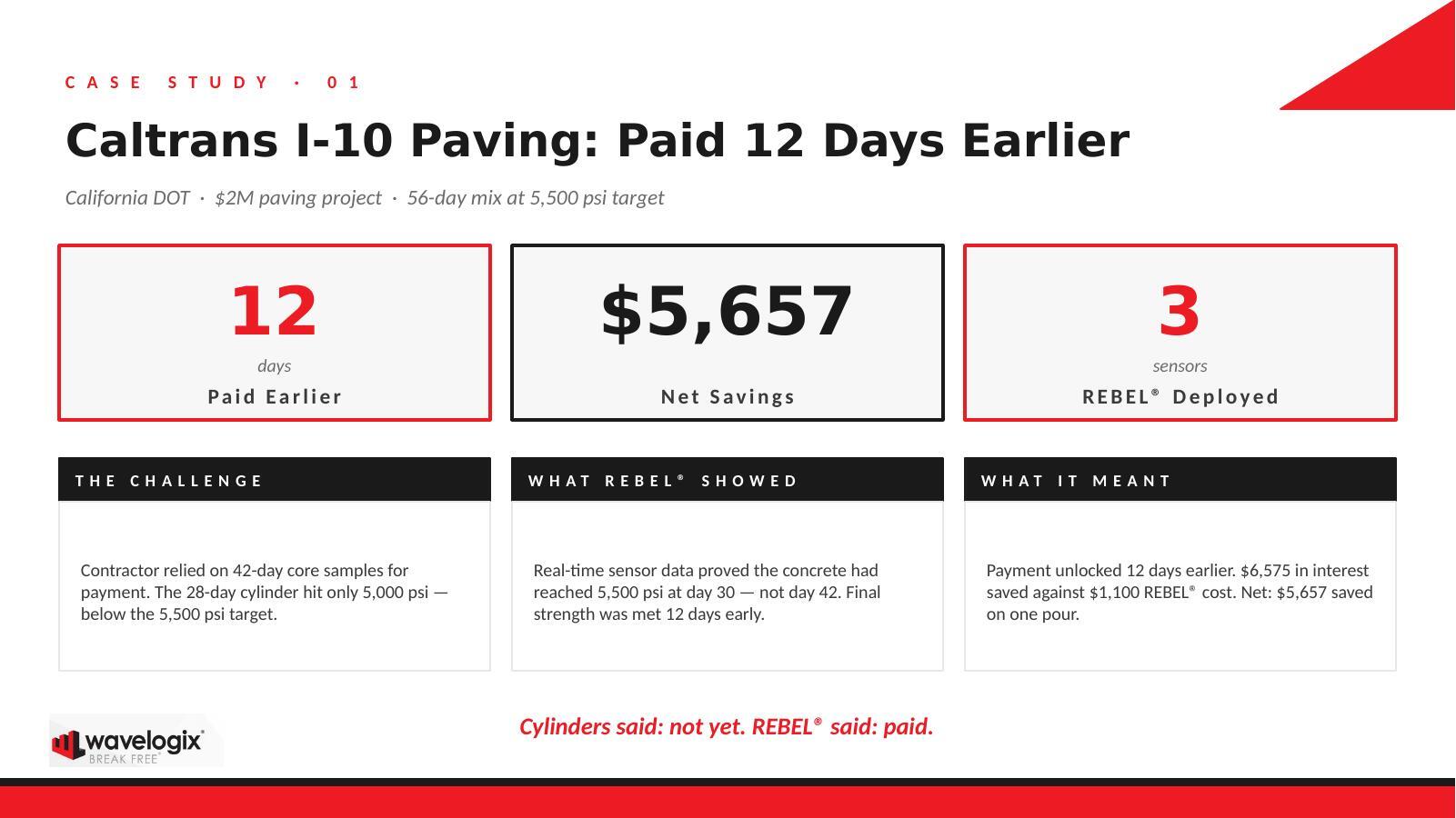
On a California DOT project, a 28-day cylinder read only 5,000 psi against a 5,500 psi target — suggesting the project needed to wait. REBEL® data showed the concrete had actually hit 5,500 psi at day 30, not day 42. Payment unlocked 12 days early. Net savings after sensor cost: $5,657.
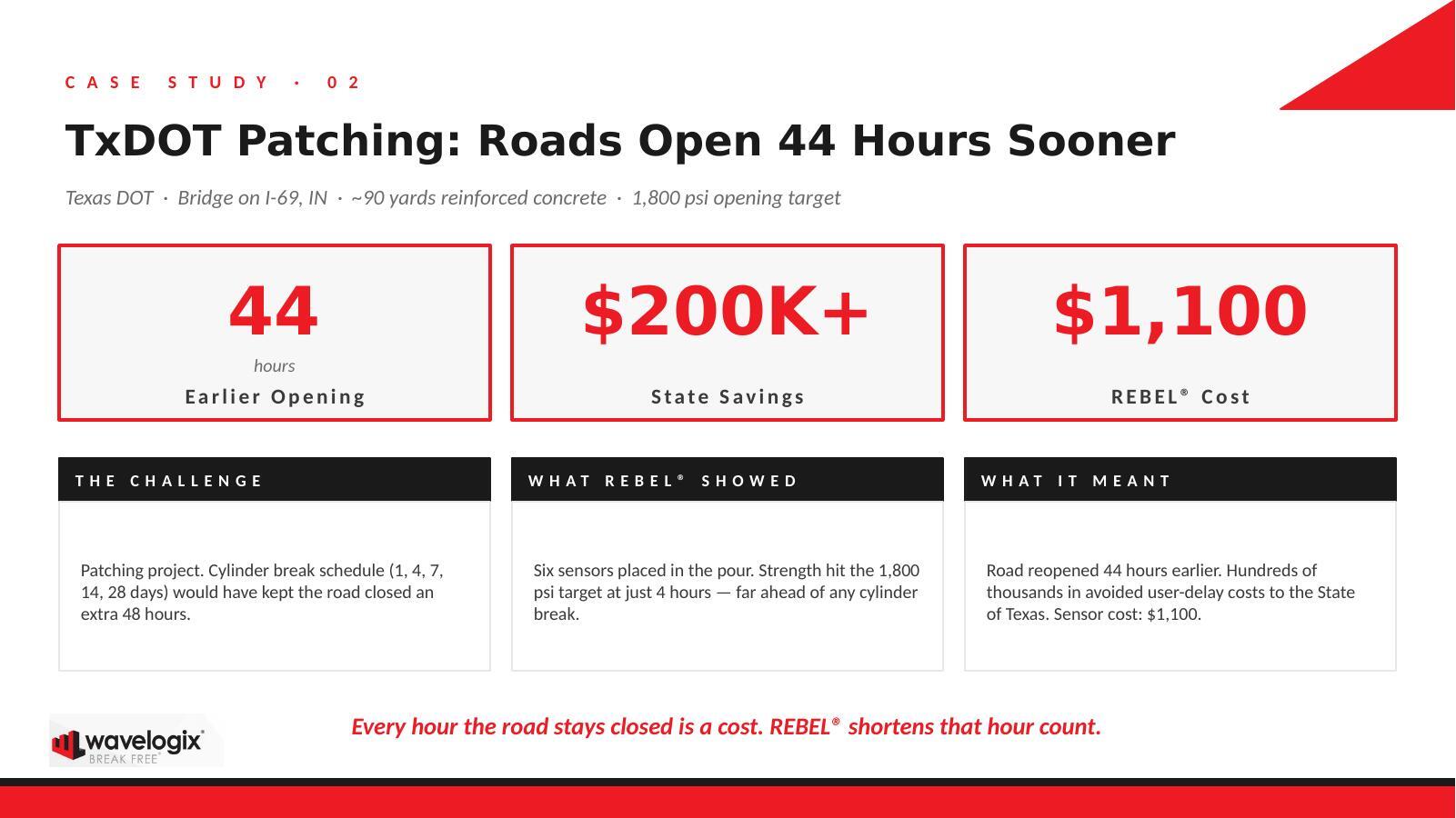
On a Texas DOT bridge patch, six sensors confirmed that the 1,800 psi opening target was reached in just 4 hours, far ahead of any cylinder break schedule. The road reopened 44 hours early, avoiding hundreds of thousands of dollars in user-delay costs for $1,100 in sensor costs.
Deploying on Your Next Iowa Project
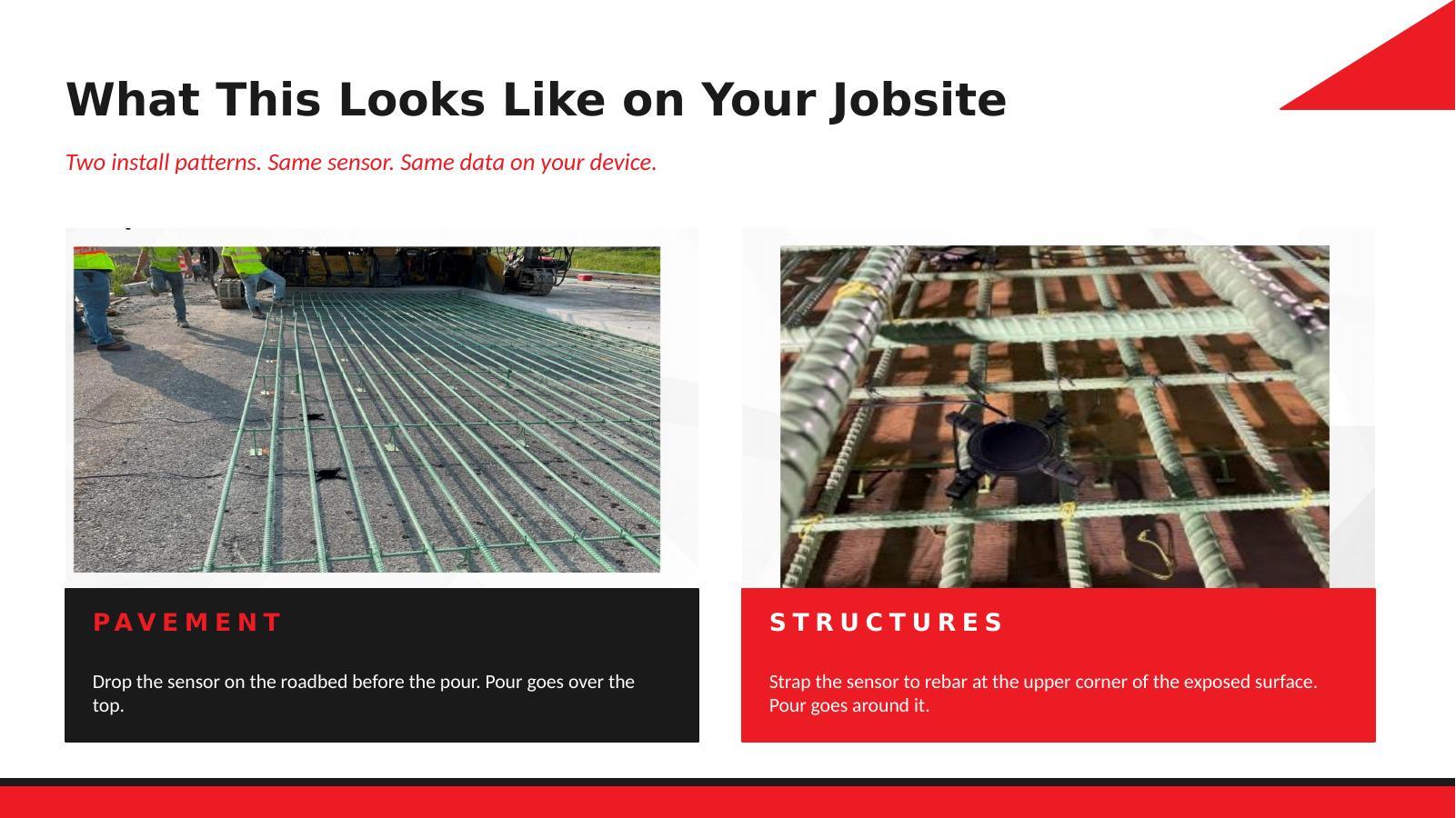
Installation is straightforward and follows two patterns depending on project type. For pavement: drop the sensor on the roadbed before the pour, piezoelectric side up, with 6 inches of concrete cover and 2 inches of clearance. For structures: strap the sensor to rebar at the upper corner of the exposed surface. In both cases, the sensor detects the pour and begins transmitting automatically.
"Once you get comfortable with it, you never want to go back. You never want to go back to cylinder breaks, you never want to go back to maturity. It's so easy to deploy and use. It just makes perfect sense."
— Joe Turek, CEO, Wavelogix · closing remarksWhat's Next
Iowa is the first state to formally approve AASHTO T412 for concrete strength certification and payment on DOT projects, but Turek made clear it won't be the last. Wavelogix is currently working with 34 states on adoption, with roughly 10 that the company expects could write the technology into their specs before the end of 2026.
"The folks in Iowa, you are trailblazers and leaders of the country," Turek said in his closing remarks. "Those that work in multiple states, once you start using the sensor in Iowa, talk to your DOT and say, let's get on board here."
The webinar recording and slide deck will be distributed to all registrants. Iowa contractors ready to deploy can reach Wavelogix at sales@wavelogix.tech or request a quote through www.wavelogix.tech. Packages start at $3,350 (Apprentice), $4,750 (Journeyman), or $8,750 (Professional), with sensors available for individual purchase at volume discounts after the initial kit.
Ready to Replace Your Cylinders?
Iowa IM 383 is in effect now. Wavelogix ships from stock — sensors can be on your site tomorrow. Contact our sales team now to learn more.