

The ready-mix concrete industry is experiencing the most rapid materials and technology shift in...
As demand increases, margins tighten, and accountability expectations rise, ready-mix producers are facing some of the most complex operating conditions in decades. Material variability, staffing shortages, uptime pressures, and shifting environmental requirements are reshaping the very foundation of quality control (QC).
These pressures—and the opportunity hidden within them—were the focus of Wavelogix’s December Industry Insights Lunch & Learn featuring James D. Randolph, Executive Director of the Illinois Ready Mixed Concrete Association (IRMCA), and Joe Turek, CEO of Wavelogix.
 With more than 47 years in concrete production and a decade leading IRMCA, Randolph has witnessed nearly every challenge the industry can face. During the discussion, he summarized the central QC vulnerability in a single sentence:
“The gap we’ve never been able to monitor is what happens from the chute to curing.”
— Jim Randolph
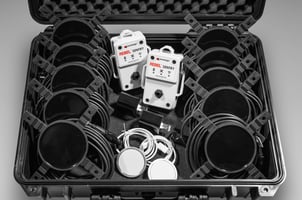
That gap—long considered unavoidable—is precisely what Wavelogix’s REBEL® Concrete Strength Sensing System is now illuminating in real time.
Why QC Breakdowns Are More Common—and More Costly
A System Under Pressure
Concrete production happens under intense operational constraints:
- A 60–90-minute delivery-and-discharge clock
- Continuous changes in weather, traffic, crew availability, and site readiness
- Large pours requiring precise timing between batches
- Multiple job sites pulling from the same plant
Randolph described this reality with blunt accuracy:
“Our life is fluid—it’s like playing the Super Bowl without a quarterback.”
Even before QC testing begins, the process is stretched thin.
The Human Factor: QC’s Biggest Variable
Plants today operate with remarkable precision—tighter tolerances, better automation, and consistent materials. But human variability remains stubborn:
“Personnel… People are trained. Procedures are qualified. But fatigue, weather, and undersized crews create variability.”
— Jim Randolph
Randolph recounted examples of cylinder mishandling that would make any QC manager shudder: uncured cylinders traveling 90 minutes in the back of a pickup truck, curing boxes left uncovered in full sun, and improperly collected samples leading to catastrophic misreads.
These aren’t edge cases; they are systemic problems across the industry.
Cylinder Testing Is Becoming a Bottleneck
Cylinder breaks—in theory a gold standard—too often fail to reflect actual in-place performance. They are:
- Easy to mishandle
- Hard to validate
- Slow to process
- Frequently misaligned with real placement conditions
Randolph told the story of a technician arriving late to a pour, scooping concrete straight off the chute, capping cylinders on-site, and driving them an hour and a half to the lab while still wet. Every cylinder failed.
The financial fallout of a single false negative can wipe out the margins on hundreds of cubic yards.
Real-Time Strength Monitoring: A Breakthrough in QC
Replacing Guesswork with Direct Measurement
Traditional maturity methods—while useful—come with limitations:
- They rely solely on temperature rise
- Their accuracy fades after the early hydration window
- They require mix-specific calibration curves
- They cannot reliably project 14-, 28-, or 56-day strengths
The REBEL® System takes a fundamentally different approach.
Using an acoustic resonance method pioneered at Purdue University, REBEL measures stiffness and internal material behavior directly from inside the concrete mass. This enables continuous, accurate strength prediction—from minutes after placement through 56 days and beyond.
 As Turek explained:
“We’re measuring the structural modulus in real time, in situ, non-destructively—from the moment it’s poured to 56 days and beyond.”
This capability aligns with AASHTO T-412, the emerging pathway for cylinder- and beam-free certification.
Data Everyone Can Trust
Because acoustic signals can’t be manipulated or influenced on-site:
“You cannot fake an acoustic signal.”
— Joe Turek
Whether deployed by a contractor, producer, or test house, REBEL produces a tamper-proof, GPS-tagged strength record both owners and DOTs can trust.
A Turning Point for State Specifications
DOTs in Indiana and Iowa are already preparing to adopt REBEL-based certification methods. Randolph, who has long advocated for performance-based acceptance, sees this shift as overdue:
“Everybody wins when concrete is accepted. Nobody wants to be in a tear-out scenario.”
Real-time strength data reduces uncertainty, accelerates acceptance, and prevents disputes before they begin.
How Real-Time Data Is Reshaping the Economics of Concrete
1. Over-Cementing Is Being Exposed
Analysis of more than 1,500 sensor deployments has revealed a striking pattern: many mixes are reaching design strength far earlier than expected—often within 7–14 days.
“We are over-cementing as an industry—often by 10–20%.”
— Joe Turek
With validated strength curves, producers can safely optimize mix designs, reducing costs and carbon footprints simultaneously.
2. Faster Openings, Higher Throughput
Reliable early strength data allows:
- Earlier form removal
- Faster paving lane openings
- More predictable crew scheduling
- Fewer penalties and delays
In an environment where time truly is money, these gains compound quickly.
3. Fewer Cylinders = Lower QC Spend
The potential cost reduction is significant:
“If you can eliminate cylinder and beam breaks, you cut QC costs in half.”
— Joe Turek
Randolph added that even a simple $10,000 credit can erase profit on hundreds of cubic yards—costs that real-time data helps prevent entirely.
Why Producers Are Calling REBEL a QC Game Changer
1. It Closes the Chute-to-Cure Blind Spot
Producers now have continuous visibility into:
- Strength development
- Placement quality
- Curing conditions
- Mix consistency throughout the day
One emerging best practice involves placing a REBEL sensor inside a cylinder made at the plant—creating a QC baseline immune to jobsite handling errors.
“If something fails on-site, we can say: the sample at the plant was perfect. Let’s look at jobsite handling.”
— Joe Turek
2. It Creates a Shared Source of Truth
The REBEL dashboard allows producers, contractors, test labs, DOTs, and owners to see the same real-time data simultaneously.
“Everyone can pull it up on their phone and sleep well knowing the concrete is performing.”
— Joe Turek
3. It’s Designed for Field Reality
Quick installation—such as dropping sensors on a roadbed or strapping them to rebar—makes adoption straightforward. Most producers run REBEL in parallel with cylinders for a project or two before making it part of standard practice.
What’s Coming Next: The 2026+ Outlook
Real-Time Strength Will Become a Spec Requirement
Owners and agencies increasingly expect transparent, continuous QC. Real-time data is poised to shift from “innovative” to “expected.”
DOTs Will Embrace Performance-Based Acceptance
Randolph noted that Illinois is already working toward unified QC/QA frameworks and digital acceptance pathways—transformations that real-time data will accelerate.
Sustainability and Cost Pressures Will Drive Adoption
Real-time insights reveal opportunities to:
- Lower cement factors
- Improve SCM performance
- Reduce waste
- Prevent tear-outs
These are competitive advantages in a cost- and carbon-conscious market.
A New Generation Is Ready
Younger QC professionals—raised on digital tools—are quick to adopt technologies like REBEL:
“The next generation is learning through webinars and podcasts. They’re ready for innovation.”
— Jim Randolph
Conclusion: The Industry Is Ready—and the Technology Is Mature
Randolph and Turek’s conversation underscored a simple reality:
Producers are already doing everything right inside the plant.
The failures happen after the chute.
Real-time strength monitoring closes that gap—permanently.
With REBEL and AASHTO T-412, producers gain:
- A third-party verifiable strength record
- A pathway to eliminating cylinders and beams
- Faster, safer project delivery
- Stronger data defensibility
- Lower QC costs
- Protection against avoidable disputes
- A foundation for more sustainable mix design
As Turek put it:
“Concrete performs exactly as designed—data tells the story your mix already knows.”
The future of ready-mix QC will not be defined by guesswork or tradition. It will be defined by real-time data. If your team is ready to learn more about how we can help, contact us and we can review your project needs together.