
/Wavelogix%20Webinar%20Smart%20Concrete%20Solutions%20for%20Municipalities%20-%20webinar.jpg?height=200&name=Wavelogix%20Webinar%20Smart%20Concrete%20Solutions%20for%20Municipalities%20-%20webinar.jpg)
Municipalities across the country face a common challenge: balancing limited staff resources with...
Every year, American drivers lose 4 billion hours sitting in construction zones. Not commuting. Not running errands. Just waiting behind cones, reduced-speed signs, and lane closures for road work to finish.
Add to that 3 billion gallons of wasted fuel, and you start to understand why road construction feels like one of the country's most reliable frustrations.
Most people assume the delay is unavoidable. Concrete takes time to cure. Materials have to be ordered. Crews have to coordinate. All of that is true, but a significant portion of that wait has nothing to do with any of those things.
It comes down to a 180-year-old testing method and nobody being able to tell you in real time whether the concrete is actually ready.
That method is changing. And one more state just made it official.
America's Roads: The Grade Says It All
The American Society of Civil Engineers gave US infrastructure a C in its 2025 report card. That's the highest score the country has ever received, and it still reflects a system under serious strain.
The country has more than 46,000 structurally deficient bridges. Surface transportation needs an estimated $3.5 trillion in investment through 2033. A single day of highway disruption can produce between $8 million and $256 million in economic losses, depending on how busy the road is and how long traffic backs up.
The Infrastructure Investment and Jobs Act, the largest federal road investment in decades, expires in September 2026. Congress is deciding right now what comes next.
All of which makes what happens on individual job sites more consequential than it might seem. Because even with the right funding and the right materials, projects stall when the people running them can't answer a basic question: is this concrete strong enough to open yet?
The Test That's Been Running the Show
When concrete is placed on a highway, bridge deck, or pavement repair, it must reach a minimum compressive strength before traffic can safely return. That threshold exists for good reason. Opening too early can reduce the lifespan of the structure and lead to long term performance issues.
The challenge isn't the threshold. It's how concrete strength gets verified.
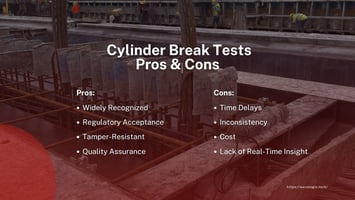
The traditional process works like this: workers pour the concrete, then separately fill cylindrical molds with samples of that same mix. Those cylinders get transported to a third-party lab. Lab technicians cure them under controlled conditions and eventually crush them in a hydraulic press. The number that comes back tells the crew when the road can reopen.
This method has been the backbone of concrete quality control for over 180 years. In many states, it still is.
There's a problem built into it. The cylinders being tested are not the concrete in the road. They're cured in different conditions, transported by different people, and tested days or weeks after the pour. The commonly referenced 28-day strength milestone, often treated as gospel in the industry, is described in engineering guidance as an arbitrary specimen age chosen to standardize timelines, not because it reflects when concrete becomes structurally usable. In most cases, concrete reaches 65 to 70 percent of its design strength within the first week.
But without a way to verify that in real time, in the actual road, crews default to waiting. And when lab results come back low, the delays compound further through retesting, core drilling, and potential project halts. Even when the results come back fine, the question lingers: was the problem the concrete, or was it the test?
That question drove the research that changed the answer.
What 32 State Departments of Transportation Found Out
In 2021, the Indiana Department of Transportation came to Purdue University with a question: What if there were a better way?
Dr. Luna Lu and her team had been working on that answer since 2017. The result was the REBEL concrete sensing system. It’s a small sensor embedded directly in a fresh concrete pour that measures the actual elastic properties of the concrete as it cures, transmitting real-time strength data to a phone or laptop on the job site. No cylinders. No lab. No waiting.
What happened when we started testing it across state DOT projects is where the numbers get interesting.
In a partnership with the Indiana Department of Transportation, we ran an eight-week trial on road patching projects. Under current specifications, patched roads typically remain closed for three days before reopening. During the trial, REBEL sensors indicated that target strength was achieved in four to five and a half hours. In one case, the data showed that the concrete had reached required strength 44 hours before the cylinder results confirmed the same.
Across 32 state DOTs, more than 1500 sensors have been deployed on over 60 projects, including highways, bridges, and pavement repairs. The results have shown consistent performance. REBEL's measurement variability came in at 12.2 percent. Cylinders, across the same projects, showed 27.9 percent. This represents a significant difference in consistency and reliability.
"REBEL reduces schedule uncertainty. With true in-place data, you can make earlier, safer calls and document every decision for compliance and owner review," said Dr. Luna Lu, Wavelogix's founder.
Iowa Just Made It Official
For most of the country, adopting real-time concrete strength monitoring has been a matter of interest — states could try it, run pilots, and study the results, but cylinder breaks remained the required method for strength certification and payment.
Iowa changed that on April 21, 2026. On that date, Iowa DOT formally updated Matls. IM 383 to approve acoustical resonance sensing, the method behind REBEL®, as an accepted method for concrete strength certification on Iowa DOT projects. The Engineer now accepts real-time, in-place sensor data, in accordance with AASHTO T412, as the basis for opening the pavement to traffic and authorizing payment.
That applies to both pavements and structures.
The practical meaning: on Iowa highway, bridge, and pavement repair projects, contractors no longer have to wait for a lab to crush a cylinder before a road can reopen or an invoice can be paid. If a REBEL sensor embedded in the concrete shows that the required compressive strength threshold has been reached, the Engineer can authorize opening. The 28-day wait is no longer a default; it's optional.
Iowa IM 383 specifies the thresholds directly: 350 psi flexural required → sensor must read 2,750 psi compressive 500 psi flexural required → sensor must read 3,850 psi compressive 575 psi flexural (structural forms) → sensor must read 4,400 psi compressive
The updated spec also addressed one of the most common questions contractors ask: who handles calibration? Under Iowa IM 383, there is no contractor-side calibration burden. There are no beams to cast, no mix-specific curves to develop, and no 90-day revalidation cycles. The sensor verification is performed annually by the manufacturer. Contractors submit the manufacturer's calibration records. That's it.
It's a meaningful operational difference from the maturity method, also permitted under IM 383, which requires casting 12 test beams before a project begins, building a mix-specific strength-maturity curve, and revalidating that curve every 90 days of production. REBEL works on any mix from the first hour of the first pour, without any of that setup.
Iowa is the latest in a growing line of states formalizing what the research has already shown. But the significance here goes beyond one state's specification update. Iowa DOT is a respected standards-setter in the Midwest, and its adoption carries weight with other state agencies watching from the sidelines.
The Policy Gap
In July 2024, the American Association of State Highway and Transportation Officials formally recognized this approach as a new national standard: AASHTO T412-24. That means any state DOT can now adopt real-time concrete sensing as their primary testing method and be in full compliance with national specifications.
Thirty-two states have already tried it with consistent results. However, most projects across the United States still rely on cylinder testing as the primary method of strength verification.
Part of this is institutional. State DOTs move slowly, and understandably so since the consequences of a structural failure are severe. Part of it is procurement.
With the IIJA expiring and Congress evaluating the next transportation bill, there's a real opening to change that. Any new federal infrastructure funding could reasonably include a requirement that projects above a certain size deploy real-time concrete strength monitoring on concrete pours.
The technology is available. It's AASHTO-approved. It has been validated across multiple states and project types. The remaining question is how quickly it will be adopted at scale.
What Those 4 Billion Hours Are Worth
The 4 billion hours lost each year affect daily commutes, parents picking up their children, freight movement, and local economies. Extended construction timelines disrupt businesses, delay deliveries, and limit access for emergency services.
Not every delay can be eliminated. Construction projects are complex, shaped by weather, logistics, and coordination across multiple teams. But eliminating the wait time caused by outdated measurement methods is an achievable improvement right now.
In the Indiana trial, a three-day wait became less than half a day. That's not a marginal improvement. That's a different kind of project delivery.
The infrastructure crisis in America is real, and it won't be solved by any single technology. But knowing in real time whether the concrete is ready, rather than waiting on lab results from cylinders that don't represent actual field conditions, is one of the most direct and achievable fixes available today.
The question isn't whether it works. It's how many more projects have to wait before it becomes the norm.