

Roller-compacted concrete (RCC) has long been celebrated as a game-changer in paving and industrial...
Concrete maturity testing is a widely used field method for estimating in-place concrete strength based on temperature history. When properly implemented, it allows project teams to make earlier, strength-dependent decisions—such as form stripping, post-tensioning, joint sawing, or opening pavements to traffic—without having to wait for laboratory test results, which can often be delayed
However, maturity testing does not directly measure strength. It estimates strength through correlation, which means its reliability depends on calibration quality, mix stability, curing conditions, and how closely field conditions match those assumed during curve development.
This article explains how the maturity method works, what ASTM C1074 requires at a practical level, common limitations encountered in the field, and when alternative or complementary methods may provide higher confidence.
Key Concepts at a Glance
- Maturity estimates strength based on time and temperature, not direct material response
- Strength-maturity relationships are mix-specific
- Changes in materials, curing, or placement conditions can reduce accuracy
- Maturity is often paired with validation testing for confidence
- In some scenarios, more direct in-place measurement methods may be appropriate
What is a Concrete Maturity Test?
A concrete maturity test estimates in-place compressive strength by tracking concrete temperature over time and converting that temperature history into a maturity index. That index is then mapped to strength using a pre-established strength-maturity relationship, commonly referred to as a maturity curve.
It’s important to remember that maturity does not test strength. Instead, it infers strength based on how the concrete behaved during calibration.
Typical Applications of Concrete Maturity Testing
Maturity testing is often used on projects where understanding early strength development is critical for scheduling, safety, and quality control. These projects include:
- High-rise buildings and parking structures
- Bridges, pavements, and infrastructure repairs
- Early formwork removal and fast construction cycles
- Mass concrete placements
- Temperature-sensitive pours
- Cold-weather and hot-weather concreting conditions
How the Maturity Method Works
1. Measuring In-Place Temperature
Embedded sensors record concrete temperature at regular intervals. Sensors are placed in locations relevant to the decision being evaluated, such as critical sections for stripping or opening to traffic.
2. Calculating Maturity
Most systems calculate maturity using one of two approaches:
- Time-Temperature Factor (Nurse-Saul): simple and widely used
- Equivalent Age (Arrhenius-based): more robust across wider temperature ranges
Both methods reduce temperature history to a single maturity value.
3. Estimating Strength
The calculated maturity value is converted to estimated compressive strength using the maturity curve for the project’s specific mix.
Developing a Concrete Maturity Curve
A maturity curve is the foundation of accurate maturity testing. A typical development process includes:
- Selecting the exact project mix (cement, SCMs, admixtures, aggregates, proportions)
- Casting representative specimens
- Recording temperature in the specimens
- Curing under documented conditions
- Breaking specimens at multiple ages relevant to project decisions
- Calculating maturity at each break
- Establishing the relationship between maturity and measured strength
Rule of thumb: Making meaningful changes to cement source, SCM content, admixture package, or proportions generally requires a new curve or, at minimum, re-validation.
ASTM C1074: A Practical Overview
ASTM C1074 is the primary standard governing maturity-based strength estimation. In practical terms, it addresses:
- Establishing a strength-maturity relationship for a given mix
- Recording temperature and calculating maturity in the field
- Using the maturity curve to estimate in-place strength
- Emphasizing calibration, validation, and documentation
Project specifications often add additional requirements, particularly around acceptance testing and verification.
Where Maturity Testing Performs Well
Maturity testing is particularly effective when:
- Early-age decisions are schedule-critical
- Weather conditions vary and time alone is unreliable
- Mix designs are stable and repeatable
- Teams maintain calibration discipline
In these cases, maturity provides better insight into early strength development than time-based assumptions.
Common Limitations of the Maturity Method
Mix Sensitivity
Maturity curves are mix-specific. Changes in materials or proportions can alter strength gain behavior and invalidate the correlation.
Curing and Moisture Effects
Maturity is driven by temperature history, but hydration also requires adequate moisture. Poor field curing can result in lower strength even when maturity appears favorable.
Temperature Extremes
Simplified maturity models may lose accuracy in very cold or very hot conditions where hydration behavior deviates from assumed relationships.
Field vs. Calibration Conditions
Differences in consolidation, finishing, curing, and exposure between lab specimens and field placements can lead to mismatches between estimated and actual in-place strength.
Sensor Placement and Thermal Gradients
A single sensor represents one location. Large placements, edges, corners, and thick sections may experience different temperature histories and strength development.
Best Practices for Using Maturity Effectively
- Calibrate the exact mix used on the specific project
- Protect concrete from early moisture loss
- Place sensors in conservative, decision-critical locations
- Validate periodically with companion testing
- Use maturity for early operations while maintaining required acceptance testing
Comparing Maturity Sensor Types: Wired vs. Wireless
Wired Sensors
Wired sensors collect temperature and strength data with physical cables that are connected to external data loggers. They often require more setup than wireless sensors and can be vulnerable to wire damage on active jobsites. Measurements are typically collected manually.
Wireless Sensors
Wireless sensors are fully embedded in the concrete with no exposed wires, making installation simpler and safer. They transmit data wirelessly to a mobile device, so external data loggers are not needed. The collected temperature data, combined with mix calibration information, is used to estimate in-place concrete maturity and strength, and can be easily shared with project teams.
Alternatives and Complementary Methods to Maturity Testing
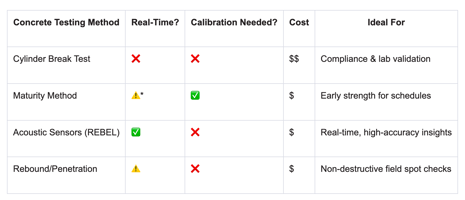
There are several alternatives to maturity testing, ranging from traditional destructive methods to newer in-place sensing technologies. The right choice depends on your project type, mix stability, and what decisions you need to support.
Traditional Destructive Testing
Cylinder breaks and core samples are the most established methods. Cylinders are standardized but delayed, and field-cured samples may not reflect actual in-place conditions. Cores provide direct in-place evidence but are invasive and typically taken later in the project when there is already a concern.
In-Place and NDT / Partially Destructive Methods
Rebound hammer, penetration resistance, ultrasonic pulse velocity, and pullout or pull-off testing each offer a way to gather in-place information without waiting on lab results. Each method has strengths and limitations and often requires its own correlation to strength.
Acoustical Resonance
Acoustical resonance sensors embed directly in the concrete before the pour and measure how the material's mechanical properties change as it cures. Unlike maturity, acoustical resonance does not rely on temperature history or a pre-built calibration curve. It works across mix designs and continues to produce reliable data beyond the early-age window where maturity is most accurate.
Maturity Testing vs. Acoustical Resonance: A Method Comparison
When maturity testing is properly calibrated and mixes stay consistent, it works well for early-age decisions. Where it starts to break down is when mixes change, curing conditions vary, or you need reliable data past the first few days of cure when temperature effects become less meaningful.
That's when acoustical resonance becomes a good alternative to maturity testing. Because it reads the concrete directly rather than inferring strength from temperature, acoustical resonance is not affected by mix changes and does not require recalibration. For teams that deal with multiple mix designs, variable site conditions, or projects that need monitoring through 28 days and beyond, it removes the biggest sources of uncertainty that come with maturity.
To see how the two methods compare across the factors that matter most on a job site, use the table below.
| Maturity Method (ASTM C1074) | Acoustical Resonance (AASHTO T-412) | |
|---|---|---|
| How strength is estimated | Inferred from temperature history and a pre-built calibration curve | Measured directly from in-place concrete properties |
| Calibration required | Yes - mix-specific curve developed in lab before deployment | No - works across mix designs without prior calibration |
| Impact of a mid-project mix change | Requires a new curve, which can take weeks and cost thousands | No impact - the sensor is not tied to a specific mix |
| Variability | ~130 psi across placements | ~63 psi across placements |
| Accuracy vs. core samples at 28 days | Cylinder-dependent; field variability common | 16% closer to core strength than field-cured cylinders |
| Monitoring duration | Reliable primarily in early age; less accurate beyond 3 days when temperature stabilizes | Up to 56 days and beyond |
| Setup cost | Several thousand dollars in lab time and beam casting | No lab prep required |
| Governing standard | ASTM C1074 | AASHTO T-412 |
Both methods provide real-time data and support early-age decisions. The core difference is that maturity infers strength from temperature, while acoustical resonance measures it directly.
Considerations for In-Place Concrete Performance Monitoring
Because maturity is an indirect estimator, its reliability can decline when mixes change, curing varies, or thermal gradients are significant. In those cases, approaches that reflect actual in-place material behavior may provide clearer decision support.
Embedded sensing technologies—such as Wavelogix REBEL® sensors—are designed to capture continuous performance data from the concrete itself rather than inferring strength from temperature alone. Used alongside maturity or traditional testing, this type of information can help teams identify when required strength thresholds are actually reached and reduce uncertainty around schedule-critical operations.
For teams evaluating how best to support early-age decisions under variable field conditions, understanding the role of direct in-place data alongside maturity testing is a practical next step. If you have any questions which method is right for your team, please reach out to us for more information.
Frequently Asked Questions
What is the maturity method in concrete?
It estimates strength by converting time and temperature history into a maturity value and mapping that value to strength using a mix-specific curve.
Is maturity testing accepted for strength decisions?
It is widely used for early-age decision support when implemented per ASTM C1074 and project specifications. Acceptance testing requirements still apply.
Do I need a new maturity curve for every mix?
In most cases, yes. Meaningful changes to materials or proportions can shift the strength-maturity relationship.
What’s the difference between Nurse-Saul and equivalent age?
Nurse-Saul is simpler. Equivalent age models temperature sensitivity more explicitly and often performs better across wide temperature ranges.
Why can maturity overestimate strength?
Because it assumes hydration behavior based on calibration conditions. Poor curing, moisture loss, or field variability can reduce actual strength even when maturity appears adequate.
Where should maturity sensors be placed?
In locations critical to decisions and where strength gain is expected to be most conservative. Multiple sensors may be appropriate when thermal gradients are present.
What are the main limitations of concrete maturity testing?
Maturity curves are mix-specific, so any change in materials or proportions can reduce accuracy. The method also relies on temperature alone, which means it loses reliability when curing is inconsistent, moisture is inadequate, or the project extends beyond a few days when temperature effects become less meaningful.
What is the difference between maturity testing and acoustical resonance?
Maturity estimates strength from temperature history using a pre-built calibration curve. Acoustical resonance measures in-place concrete properties directly, requiring no calibration curve and no mix-specific setup. See the comparison table above for a full breakdown.
Can acoustical resonance sensors be used alongside maturity testing?
Yes. They can run in parallel as a verification layer, or replace maturity entirely on projects where frequent mix changes or variable curing make calibration-dependent methods less reliable.