
Why Does Concrete Strength Matter? Concrete isn’t fully functional the moment it’s poured—it needs...
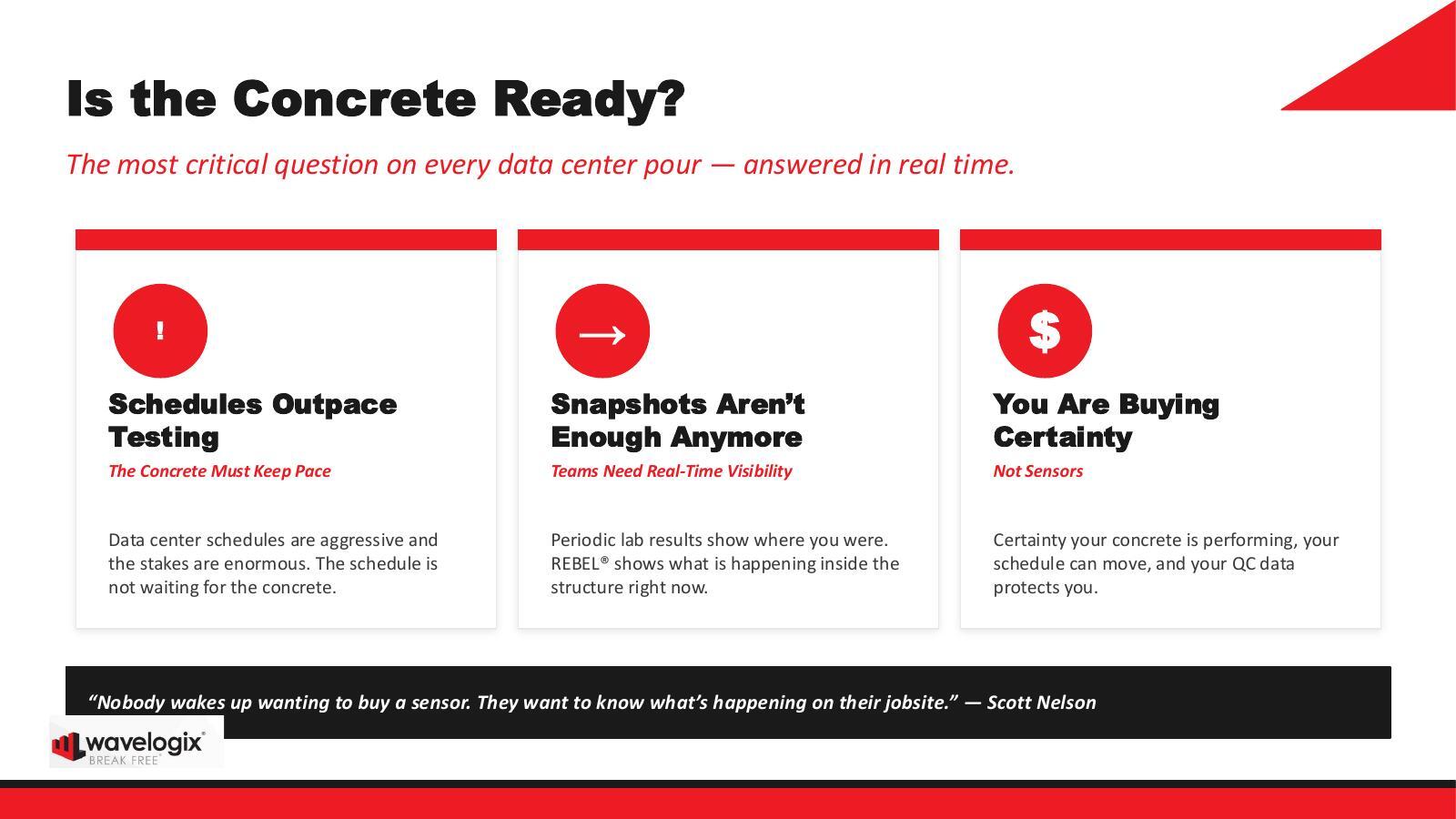
Nobody wakes up in the morning wanting to buy a sensor. They wake up wanting to know what's happening on their job site.
— Scott Nelson, Founder, Nelson QC Consulting
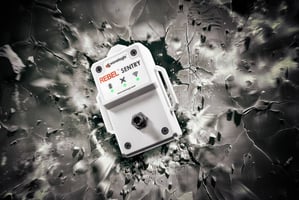
That observation drives everything about how the REBEL® Concrete Strength Sensing System was designed — and why it fits data center construction better than any other segment. Contractors aren't buying hardware. They're buying certainty.
Why Data Centers Are Different
Most construction projects follow 28-day design cycles. Data center contractors don't have that luxury. Foundations are loaded before design strength is reached. Structural elements advance to the next phase at 7, 10, and 14 days. The schedule doesn't pause while waiting for the lab.
Scott Nelson, with 40+ years in construction materials and quality control, is currently advising on active data center projects. He gave their rapid pace some perspective during our recent webinar noting, "They want to get to market as quick as possible, and they're constantly pushing the envelope — trying to speed up the schedule. They want to be done before they even start."
|
$1B+ Typical data center project cost |
7–14 Days when critical decisions are made |
60+ Cylinders cast per day on large projects |
Felicia Bahr, Wavelogix Technical Sales Specialist and a career concrete materials and QC professional, has worked on multiple data center sites. She described the operational reality of cylinder testing at that scale: "You could be making 60 cylinders a day. That's astronomical. And then you have to transport them, strip them, label them, put them in the moisture room — and on a data center site, you might not even be able to get back to where you poured because there's a crane in the way."
Multiply that scale by every day of active placement. This results in a testing agency managing hundreds of cylinders simultaneously (tracking, scheduling, and breaking them to spec) while facing the same labor shortages affecting every other sector of construction.
The Hidden Risk in the Cylinder Chain
Every concrete cylinder travels through five human-dependent steps: casting, handling, transportation, storage and curing, and testing. Each step introduces variability. And variability, at data centers' massive scale and pace, introduces risk.
The problem isn't that cylinder testing is inherently unreliable. The problem, as Nelson described it, is what cylinders actually measure. "Cylinders are representative of the ready mix that was delivered to the site," he said. "They don't give you a true representation of what's going on in the foundation, in the floor, in the wall. Sensors tell us what's going on with my concrete, in my footing, in my wall. Right now."
Key differences:
- A lab-cured cylinder reflects the mix at the time of delivery, under controlled lab conditions.
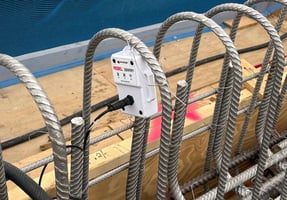
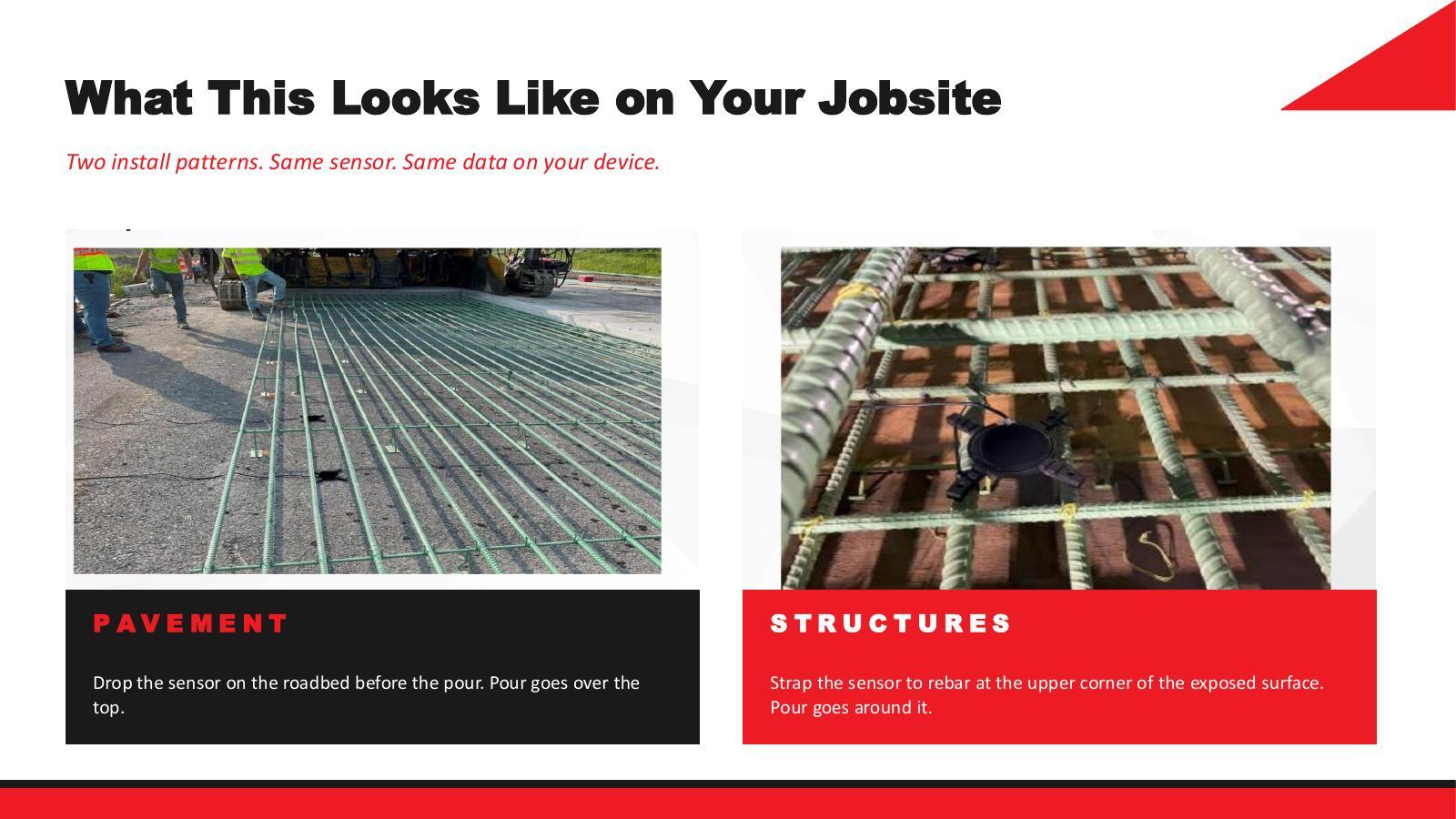
- A REBEL® sensor measures actual in-place strength as it develops inside the structure, under real field conditions, from the first hour after the pour.
Labor shortages across testing agencies are also an issue. As more data centers are built simultaneously across the country, the pool of qualified technicians isn't keeping pace. Using inexperienced technicians on large, fast-moving projects introduces additional variability into an already stretched system.
Joe Turek, CEO of Wavelogix, captured the stakes directly. He noted, "When your whole project — millions of dollars invested — is in the hands of a young, green technician collecting your data, and you don't think about QC until it's a problem, that's a real vulnerability. And these projects have very little room for error."
The $200,000 Mistake That Never Happened
The clearest illustration of what real-time sensing delivers in practice came from Scott Nelson's account of a live data center project. A structural grade beam — a critical element — had returned questionable cylinder results. The general contractor was preparing for removal and replacement. Core samples were cut. But they, too, were inconclusive. The schedule was facing a two-to-three-week delay on top of the demolition cost.
But the sensor data told a different story: strength was developing continuously and on track. The concrete was performing exactly as it should.
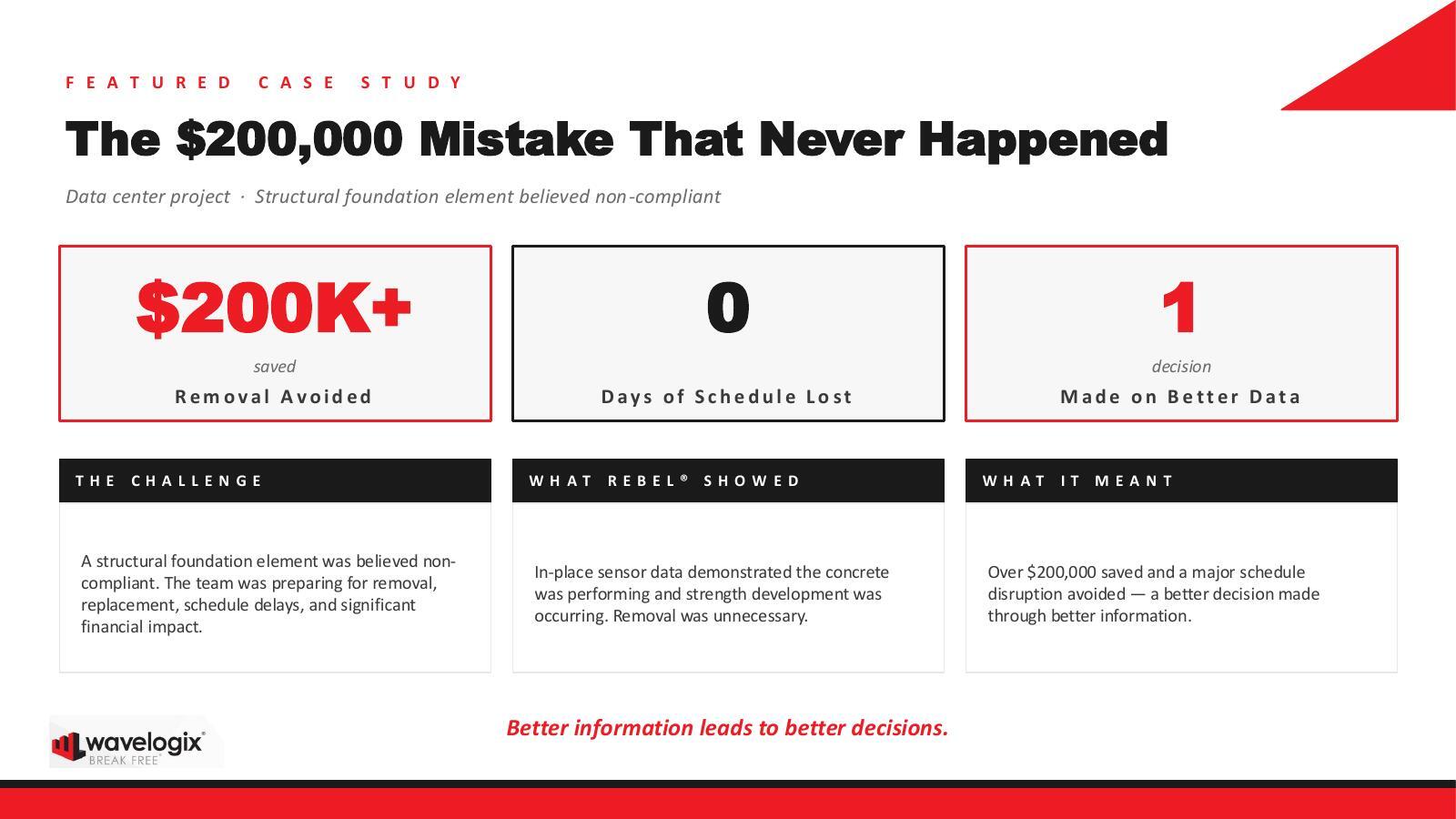
Nelson elaborated, "The contractor said, 'We put the sensors in to verify and protect ourselves, and we do have the strength.' They used the sensor data, saved over $200,000 in physical cost, and avoided pushing the schedule back two to three weeks — on concrete that wasn't even at 28-day design strength yet."
"Sensors do play a vital component to quality control," he explained. "And the general contractor, and the subcontractor that's using it — everybody buys into quality control by doing it. Therefore, we all have better data to look at."
Predictive Strength: From What Happened to What Comes Next
The REBEL® dashboard does more than report current strength. Using machine-learning algorithms trained on real-world pour data, it generates 28-day and 56-day strength projections starting after day 3. This gives project teams a forward-looking window that no cylinder program can match.
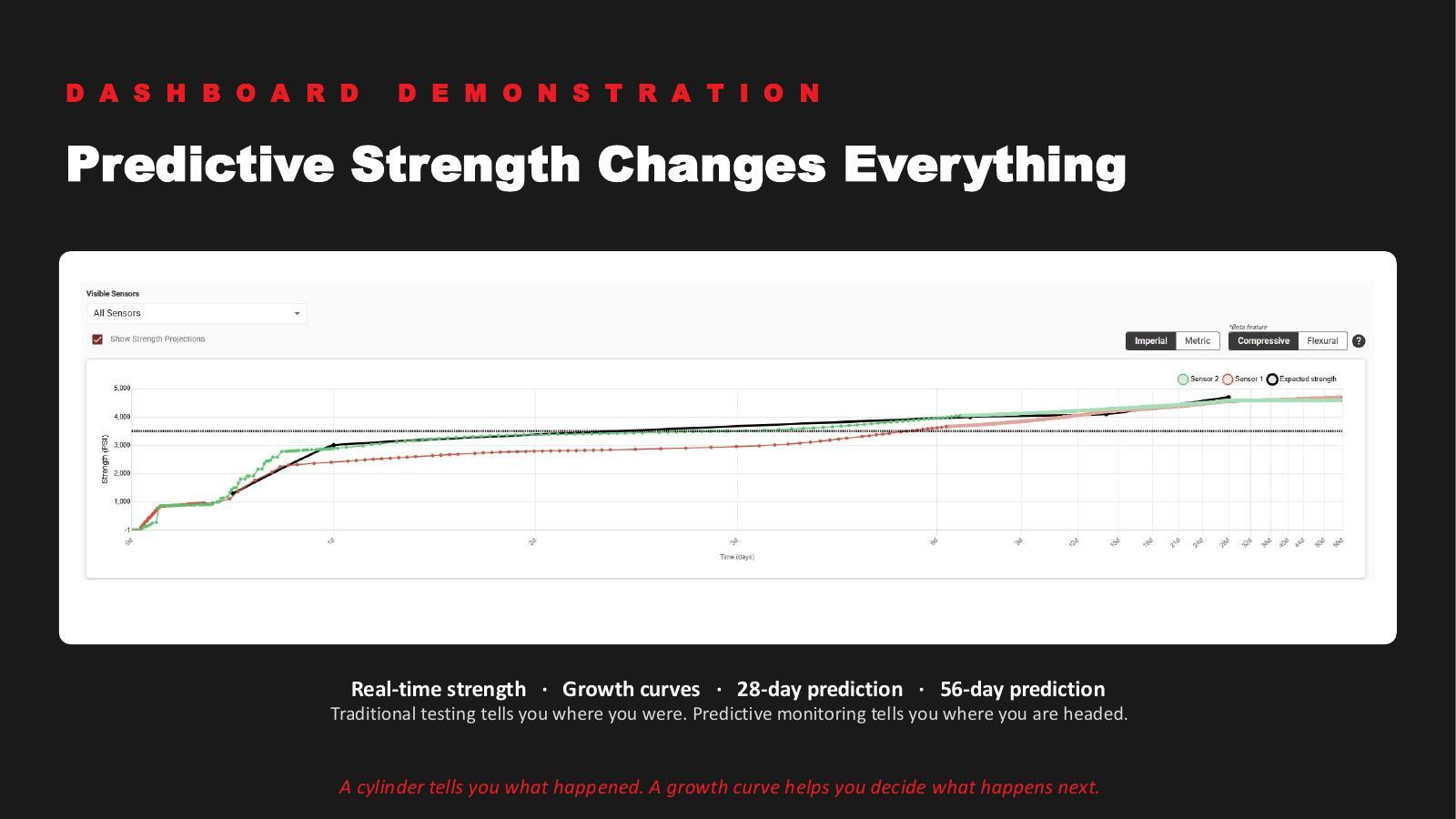
Turek elaborated about the practical value of the dashboard. "If you need to do something at 2,500 PSI," he explained, "but you're nervous about whether you'll get there — and in this chart, the certified target was 3,500 PSI but the prediction showed 5,000 at 28 days — that gives you a lot of comfort to move forward on early milestones with data behind the decision."
Bahr, who has guided contractors through data center pours with live sensor data, put the contractor reaction in plain terms. "My favorite part is the predictive analysis. I love being able to show contractors, 'You're going to meet your strength at 10 days.' And they're like, 'Wait — 10 days? I can schedule something now?' They love it."
Joe Turek added that the REBEL® system also monitors evaporation rate conditions and issues automated warnings when field conditions like wind speed, temperature, or humidity may require protective action. This is a layer of situational awareness that no cylinder program provides.
When the Data Doesn't Agree
One of the practical questions that comes up in every data center conversation: What happens when cylinder results and sensor results diverge? Which data governs?
The answer is that more data leads to better decisions — not confusion. When cylinders show a questionable result and the sensor shows continuous, appropriate strength development, the engineer has something far more valuable than a single break: a complete strength history, trend data, and a basis for targeted investigation.
| Situation | Cylinders Alone | Cylinders + REBEL® |
|---|---|---|
| The signal | One number, days later | Continuous in-place data to compare against |
| First response | Assume the worst — stop work | Targeted additional testing where it matters |
| Evaluation | Limited evidence for the engineer | Engineering judgment backed by trend data |
| Documentation | Periodic lab reports only | Complete strength history, downloadable |
| Risk exposure | Disputes, delays, rework | Mitigated with continuous data records |
Nelson put it simply, saying, "It's independent. It's like having a third-party independent laboratory, because it's just capturing the data and reporting the data. There's no calculation, no interpretation, no manipulation. It spits out the real-time data. And it gives the confidence that an engineer, owner, or anybody else can say, this is independent data. It's not compromised."
Data Center Construction Doesn't Pause for Winter
Cold-weather concrete placement creates its own layer of cost and uncertainty. Heated enclosures, insulating blankets, and standby labor are all billed by the day against a heating duration that's typically fixed by specification.
On one recent data center project, sensor data allowed the contractor to demonstrate that 75% of design strength had been reached in 3 to 6 days — two to three days ahead of the spec minimum. The owner wasn't willing to adjust the written protection requirements, but the contractor could document full compliance and build confidence with the project team for future decisions.
In other words, real-time temperature and strength data let project teams pull cold-weather protection when the data supported it, rather than when a calendar said to. This reduced heating duration and associated costs without guesswork.
Contractor-Owned QC: The Data That Protects You
One of the more significant shifts that REBEL® enables is putting quality control data in the hands of the contractor — not solely the testing agency, and not solely the owner. That independence has real value.
"The nice thing about the Wavelogix sensor is the contractor is able to take control himself again," Nelson added. "He's not relying on the owner's testing laboratory. He's not relying on somebody else. He can put the control back in his own hands and have the comfort of knowing what's going on."
Continuous strength records download directly from the dashboard. It provides a complete strength history that documents performance, supports dispute resolution, and builds a documented quality program across pours.
As Turek noted, trust is important. "The end users, the buyers of the projects, are getting more comfortable with allowing the contractors to use sensor technology that's third-party agnostic. Because you can't cheat the sensor. If you use it, you get data. The contractor can't fudge it."
The Industry Is Moving
The regulatory trajectory is already in motion. In April 2026, Iowa DOT revised IM 383 to formally recognize acoustical resonance technology (AASHTO T412) as a valid alternative to cylinder breaks and flexural beams for opening and payment decisions on both pavements and structures. Iowa was the first. Now Indiana, Texas, Tennessee, Kansas, and 30 additional states are in active testing and specification development.
The DOT adoption pathway matters for data centers because it establishes the independent validation framework that owners and engineers require before writing sensor-based QC into project specifications. According to Turek, "Ultimately, this starts becoming the de facto standard."
Data centers face the same pressure that drove DOT adoption — aggressive schedules, high financial stakes, and zero tolerance for delays — but with financial consequences that are often larger. Owners and design teams are already beginning to incorporate real-time monitoring language into QA requirements. Contractors who build the competency now are establishing a competitive advantage.
How to Get Started: Just Three Steps to Your Next Pour
Set up the Wavelogix dashboard, deploy REBEL® sensors, and watch real strength data appear from the first hour of the pour. Training, onboarding, and field support are included.
1. Scope Your Pour Program
Identify your critical placements — mats, foundations, slabs, walls — and the strength milestones that drive your schedule. Wavelogix will help confirm sensor quantities and placement per pour.
2. Get a Quote
Choose from Apprentice ($3,350), Journeyman ($4,750), or Professional ($8,750) kits. Each includes sensors and data loggers. Sensor quantity scales with your daily pour volume.
3. Deploy and See It
Onboard and set up your Wavelogix® Dashboard. Deploy REBEL® Sensors on your project.
Ready to See Real Strength Data on Your Next Pour?
On a billion-dollar data center project, confidence is valuable. But certainty — data you can rely on, documentation you can defend, decisions you can make with your eyes open — is something else entirely.