

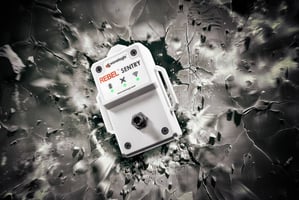

In 2021, Wavelogix partnered with INDOT and Purdue University to enhance road and bridge...
Construction season is in full swing, and so is innovation at Wavelogix. Over the past several months, our team has been listening closely to customer feedback, building new capabilities, and finding more ways to help you monitor concrete with greater confidence.
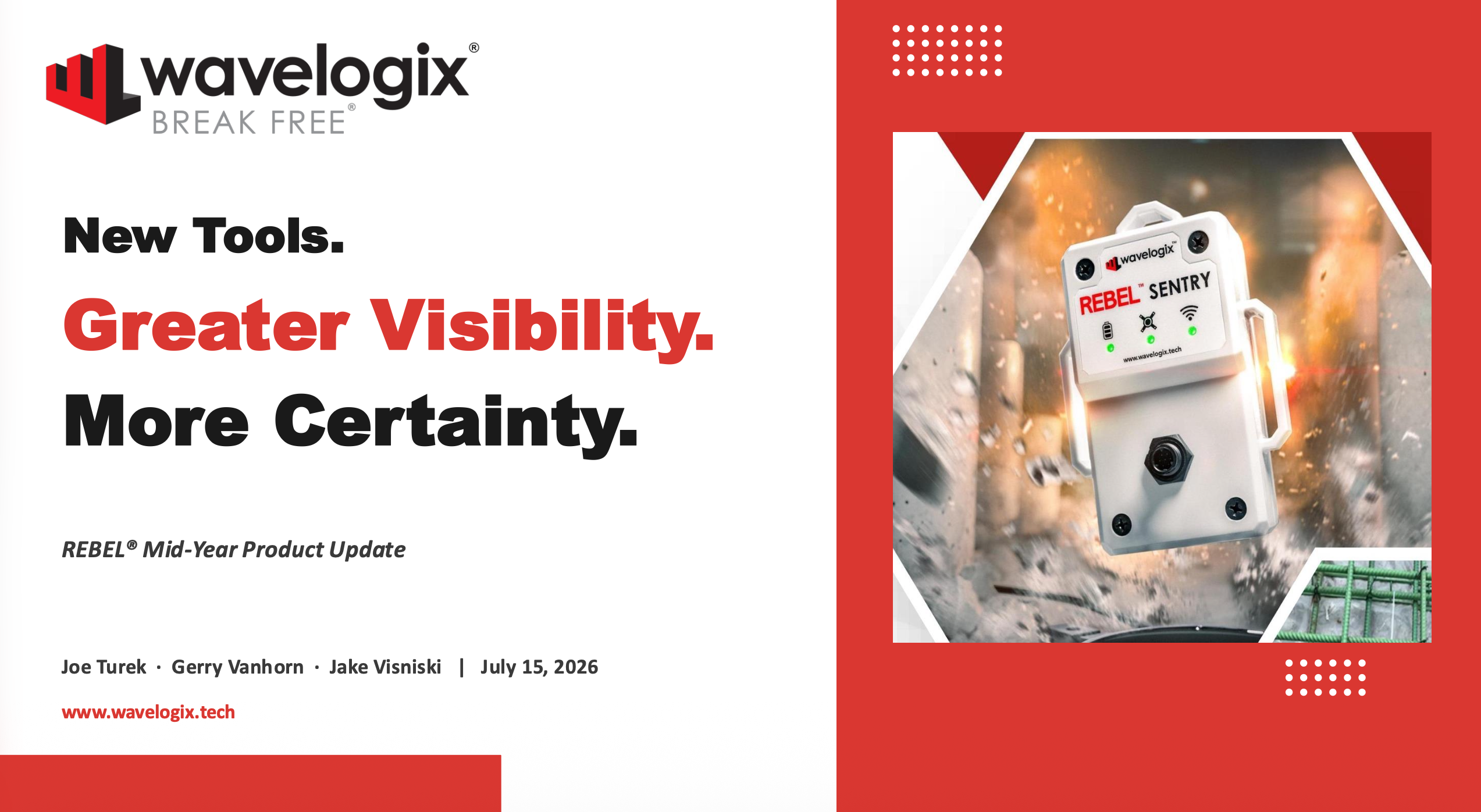
On July 15, CEO Joe Turek, Director of Product Development Gerry Vanhorn, and Applications Development Lead Jake Visniski hosted a live webinar to walk through everything that's new with the REBEL® Sensor System — from dashboard upgrades to new hardware, kit configurations, and our new online store. Here's a recap of what was covered.
Dashboard Enhancements: Less Setup, Better Data, Greater Confidence
The REBEL Dashboard has come a long way, and this year's updates make it faster to set up and easier to read.
Easier project setup. Creating a project now takes just a few clicks — name it, drop a pin on the map, and add a pour. Mix design entry has gotten simpler too: build a mix template once, reuse it across projects, and tweak individual ingredients like water content or admixtures without starting from scratch each time. Everything can be configured from a desk before anyone sets foot on the jobsite, and the person deploying sensors in the field doesn't have to be the same person who set up the project in the dashboard.
Improved data visualization. The dashboard now includes a logarithmic timeline, multi-sensor charting so you can compare sensors side by side, an Expected Strength line, and live strength readouts by sensor. Break data — cylinder, cube, core, or beam breaks — can now be entered directly with standard intervals (1-day, 3-day, 7-day) or a custom date and time, and it displays right alongside your sensor data on the same chart.
Greater project flexibility. Toggle between Imperial and Metric units, switch between compressive and flexural strength, or apply a custom flexural conversion formula if your project uses an empirical mix-specific constant. Predictive strength — REBEL's forecast of where your concrete is heading over time — can be turned on or off depending on your preference.
Better project intelligence. The dashboard now surfaces data logger battery life, cellular signal strength, GPS sensor location on a map, weather data pulled from the nearest station to your site, and version control showing which prediction model was used for each reading.
Smarter alerting. Perhaps the biggest addition is alert templates. Rather than setting up one-off alerts for every pour, you can now build a reusable template — for example, a "Standard Paving" template with alerts for certification strength, joint cutting, traffic opening, and form removal thresholds — and apply it to any pour in seconds. Temperature alerts can also be set for both the data logger's ambient reading and the sensor's in-concrete temperature, useful for mass concrete pours or cold-weather monitoring. Once an alert triggers, it's automatically disabled so you won't get repeat notifications, and you can add any teammate to the notification list.
Updated PDF reporting. Generate a professional, shareable report with mix info, strength and temperature graphs, sensor results, and site details like slump, air content, batch ticket, and truck number — plus a free-form notes section for anything else you need documented.
Product Updates: More Flexibility, More Applications
Alongside the software updates, the REBEL hardware lineup has expanded significantly.
New hardware. Sensors are now available with reflective tape for better visibility on nighttime jobsites, a hardened Datalogger Version D built for more durability in rough field conditions, and an International Datalogger supporting REBEL deployments outside the U.S. — with projects already running in India, Morocco, Brazil, the UK, Thailand, Chile, and Saudi Arabia, among other countries.
Expanded power options. On a full charge at room temperature, the latest data logger firmware delivers roughly four weeks of battery life. For longer or more extreme jobs, an extended battery strap and a "box battery" pack are now available to stretch monitoring well past 28 days.
New monitoring options. A temperature-only sensor is coming soon for applications like mass concrete monitoring. A new three-sensor splitter lets a single data logger service up to three sensors at once — mixing strength and temperature sensors as needed — which is especially useful for mass concrete pours where you want temperature readings at multiple points alongside a central strength reading. A 50-foot cable extension is also available for large sites where the standard 16-foot cable doesn't reach.
Field improvements. A new orange storage box and staking options (for anchoring a data logger to the ground) help protect equipment on active jobsites.
Expanded applications. REBEL now supports mass concrete, roller-compacted concrete (RCC), and soil stabilization base applications, in addition to standard vertical, horizontal/pavement, redi-mix, slab, and precast use cases.
Kit Configurations: Matched to Your Project
To make it easier to get started — or scale up — REBEL kits now come in three tiers:
- Apprentice Kit — 4 data loggers and 8 sensors with individual chargers. A great entry point for teams trying REBEL on their first project or two.
- Journeyman Kit — 6 data loggers and 12 sensors. Our most popular configuration, offering the flexibility most contractors need across multiple placements.
- Professional Kit — 10 data loggers and 20 sensors, plus a full charging plate that lets you charge up to 10 sensors at once instead of managing a tangle of individual cables. Built for high-volume programs.
Cylinder Sensor Kits are also available in both 4×8 and 6×12 configurations, and every component — data loggers, sensors, charging plates, storage boxes — can be purchased individually.
Introducing the Wavelogix Online Store
We've made buying REBEL as easy as using REBEL. The new Wavelogix online store, lets you purchase products, order accessories, and select kits directly online — with product information, customer resources, and a faster, easier ordering process, all in one place.
Introducing Break Free
We spend every day helping customers break free from uncertainty about concrete strength; now we're introducing a program to match. Book a meeting with our team, and we'll send you a Break Free windshield rescue tool as a thank-you. A Break Free meeting includes:
- Project review
- Sensor placement recommendations
- Mix design discussion
- Specification support
- Product recommendations
- Technical Q&A
Frequently Asked Questions
How long does the data logger battery last? With the latest firmware, you can count on roughly four weeks at room temperature. Extreme heat or cold, or weak cellular signal, can shorten that somewhat. For longer monitoring windows, an extended battery strap or box battery pack can extend runtime well beyond 28 days.
How far in advance can I set up a sensor before the pour arrives? Project setup — mix design, sensor assignment, alerts — can be done entirely from a desk, days or weeks ahead of time. In the field, we recommend deploying and powering on the sensor about an hour or two before the truck arrives to preserve battery life, though it can be set up earlier if needed.
Can the same person who sets up the project in the dashboard be different from the person deploying sensors in the field? Yes. Setup and field deployment are fully decoupled — one team member can configure everything remotely while another handles placement on site.
What's the difference between entering a flexural break and a compressive break? You can enter break data either way, but we generally recommend entering flexural beam breaks as flexural strength rather than converting them to compressive equivalents, since that's what most viewers will expect to see. If you have a custom empirical formula for converting between compressive and flexural strength, you can adjust the conversion constant to match your mix.
Does REBEL support metric units? Compressive and flexural strength, along with temperature, can be toggled between Imperial and Metric. Full metric support isn't yet available across every part of the product, but the core strength and temperature data can be viewed in either system.
What is the three-sensor splitter, and will it show up differently on the dashboard? The splitter lets one data logger service up to three sensors — any mix of strength and temperature sensors — sequentially. On the dashboard, the data appears exactly as it would if each sensor had its own dedicated data logger; there's no visible difference. It's currently in final testing, with commercial availability expected soon.
What applications does REBEL support beyond standard vertical and horizontal placements? REBEL is used across vertical, horizontal/pavement, redi-mix, slab, precast, geotech, and RCC/municipal applications, and now also supports mass concrete and soil stabilization base monitoring.
How does predictive strength work, and can I turn it off? The dashboard forecasts where your concrete's strength is heading over time based on current sensor readings, helping you anticipate when you'll hit key milestones like form stripping, joint cutting, or traffic opening — without waiting on additional cylinder breaks. It's optional and can be toggled off in the chart view if you'd rather not see it.
How do I get notified when my concrete hits a key strength or temperature threshold? Alert templates let you set thresholds — for certification strength, joint cutting, traffic opening, form removal, or temperature limits — once, and reuse them across pours. You'll get an email when a threshold is hit, and any teammate can be added to the notification list.
Where can I buy REBEL kits and accessories? Kits, sensors, data loggers, and accessories are now available through the new Wavelogix online store, in addition to working directly with your Wavelogix sales representative.
Have a feature idea or a concrete problem you'd like REBEL's data to help solve? Reach out to your Wavelogix representative or email sales@wavelogix.tech to learn more.