

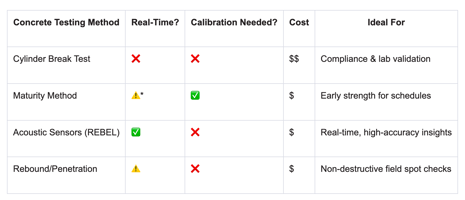
Choosing the wrong concrete testing method can cost you days, dollars, or both. There are four main...
Concrete strength is not the result of a single ingredient or adjustment. It’s the outcome of controlled decisions made throughout batching, placement, curing, and verification. When teams aim to increase concrete strength—whether in the field or in production—the most meaningful improvements typically come from tightening fundamentals rather than chasing isolated fixes.
This guide outlines the primary factors that influence concrete compressive strength and identifies practical, field-proven strategies for producing consistently stronger concrete.
What “Stronger Concrete” Actually Means
In most specifications, “stronger” refers to higher compressive strength, expressed in psi or MPa. In practice, however, strength is often evaluated more broadly. So “stronger” may also include:
- Improved durability (freeze-thaw, sulfate resistance, chloride resistance)
- Lower permeability
- Higher early-age strength for accelerated schedules
- Improved crack control and service life
A concrete mix can meet or exceed its specified compressive strength, but still underperform if placement or curing practices are poor. Strength should therefore be understood as the result of the entire process, not a single test value.
Mix Design: The Primary Driver of Compressive Strength
Water-Cement Ratio Control
The water-cement (w/c) ratio is one of the strongest predictors of compressive strength:
- Lower w/c ratios generally produce higher strength
- Higher w/c ratios increase capillary porosity, reducing strength and durability
A common field mistake is adding water to improve workability. While this increases slump, it also reduces strength and increases permeability. Therefore, a more reliable approach is to maintain a low w/c ratio and use admixtures to achieve workability.
Field note: When water is added on site, it should be documented and evaluated for its impact on strength targets.
Optimizing Cementitious Materials
Increasing cement content does not always produce stronger concrete. Beyond a certain point, excess cement can increase shrinkage and heat of hydration without proportional strength gains. And when weighing all the factors, optimizing cementitious materials often produces better results. For example:
- Fly ash can improve workability and long-term strength
- Slag cement supports later-age strength and durability
- Silica fume significantly increases strength and reduces permeability in high-strength applications
The optimal blend depends on exposure conditions, schedule requirements, and temperature.
Aggregate Quality and Gradation
Aggregates make up the majority of concrete volume, and their quality directly affects strength:
- Well-graded aggregates reduce voids and paste demand
- Clean aggregates improve bonding and consistency
- Aggregate strength can limit maximum achievable compressive strength.
Aggregate really does matter, because even well-designed paste systems can be constrained by weak or poorly graded aggregate.
Admixtures: Improving Strength Without Adding Water
Admixtures play a key part in controlling how concrete behaves. And they’re often the most efficient way to increase strength while maintaining workability:
- Water reducers / high-range water reducers: lower w/c while preserving slump
- Air entrainment: improves freeze–thaw durability (but must be carefully controlled to avoid strength loss)
- Accelerators: increase early-age strength, especially in cold weather
- Retarders: manage set time in hot conditions and reduce finishing risk
Admixtures must be properly dosed and verified through trial batching to avoid variability or finishing issues.
Batching, Mixing, and Placement: Protecting Designed Strength
Even a well-designed mix can lose strength through inconsistent execution. So again, it’s important for the process to be fundamentally sound. Here are some tips to help in that regard.
Avoid Uncontrolled Water Additions
Water added at the truck is a frequent cause of low strength results. Workability should be addressed through mix design and admixture strategy.
Proper Consolidation
Uniform consolidation appropriate to the placement should be the goal. Under-vibration leaves voids that reduce strength, while over-vibration can cause segregation.
Prevent Segregation and Bleeding
Maintaining proper slump and placement technique reduces weak zones and inconsistent performance.
Curing: Where Strength Is Ultimately Developed
Concrete strength is produced through hydration, which requires moisture and temperature control.
Moisture Retention
Early drying slows hydration and can permanently reduce strength. Best practices include:
- Initiating curing as soon as finishing allows
- Using curing compounds, wet coverings, or continuous moist curing
- Extending curing duration when SCMs are used
Temperature Management
- Hot conditions accelerate set and increase cracking risk if unmanaged
- Cold temperatures slow hydration and early strength gain
- Early-age freezing can permanently damage strength development
Reinforcement: Improving Performance Without Raising PSI
Reinforcement does not increase compressive strength test results, but it significantly improves real-world performance. In fact, structural behavior can be improved by reinforcement even when measured compressive strength remains unchanged.
Rebar and Welded Wire Reinforcement
- Improves tensile capacity and load distribution
- Controls cracking and enhance serviceability
Fibers (Synthetic or Steel)
- Improve crack control and toughness
- Reduce plastic shrinkage cracking
- Enhance post-crack and impact performance
Strength Optimization Through Performance Trends
Many mixes include a conservative “strength cushion” to ensure compliance despite variability. While effective, this approach increases cost and embodied carbon due to higher cement content.
Monitoring strength performance trends over time can support controlled optimization, allowing teams to:
- Identify consistent overperformance across multiple placements
- Detect early deviations related to materials, temperature, or curing
- Support incremental mix adjustments in coordination with the producer
When supported by consistent in-place data, optimization can be pursued more confidently and defensibly than by relying solely on occasional test results.
Implications for In-Place Strength Monitoring
Strength development varies due to the materials used, environment, and execution. When early decisions depend on strength—think form removal, opening to traffic, or post-tensioning—visibility into in-place behavior becomes increasingly important.
Systems such as Wavelogix REBEL® sensors are designed to capture continuous, in-place performance data under actual field conditions. Used alongside established QA/QC practices, this type of information can support strength verification, improve documentation, and reduce uncertainty when strength-dependent decisions must be made.
Teams evaluating methods to better align mix performance, curing conditions, and construction decisions may benefit from understanding how in-place strength data can complement existing testing workflows.
Frequently Asked Questions
Does higher cement content always mean stronger concrete?
No. Excess cement can increase shrinkage and heat without proportional strength gains. Optimization is more effective than simple addition.
Is lowering the water–cement ratio the fastest way to increase strength?
Often yes, but it must be done carefully using admixtures to maintain workability.
Can poor curing reduce final strength even if the mix is strong?
Yes. Early moisture loss or temperature extremes can permanently reduce strength.
Do fibers increase compressive strength test results?
Typically no, but they improve crack control, toughness, and post-crack behavior.
Why do strength results vary between similar pours?
Variations in temperature, curing, batching, and placement can all affect hydration and strength development.
Is early-age strength a good indicator of long-term performance?
It can be informative, but it should be evaluated in the context of mix design, curing conditions, and intended use.